
Morgan Friedman: Hey everyone, welcome to the latest episode of Client Horror Stories. After far too many reschedules, I’m honored and excited to have the one and only Rich Wright with me today. How are you doing, Rich?
Rich Wright: Doing all right, Morgan. How are you doing?
Morgan Friedman: I’m happy that we didn’t have to reschedule today. And I also want to say I really like that orange light behind you. The lantern Halloween feel sets the perfect vibe for Client Horror Stories.
Rich Wright: Cool. Very cool.
Morgan Friedman: So let’s jump in — I’m all excited to hear about your wackiest, most challenging client experience ever.
Rich Wright: Yeah, this was one that was definitely off-the-wall. You wouldn’t think that it would be taking place, but it did. And I guess that’s just par for the course. I was doing some design work for Bacardi quite a few years ago. And through that work, I was introduced to a well-known musical act here in Metro Detroit.
Morgan Friedman: Okay.
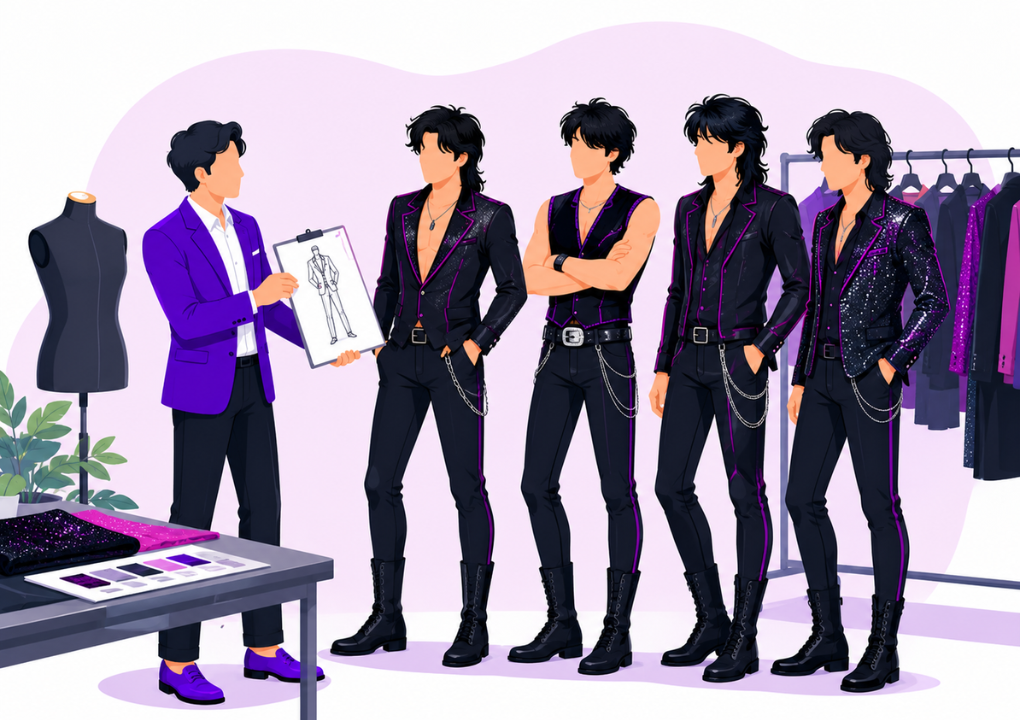
Rich Wright: And they had seen what I had been doing with Bacardi and wanted me to design some outfits for an upcoming event for them. Stage outfits and all of that. I met with them, kind of pitched myself, did that portfolio show — all that kind of stuff that everybody wants to see when you’re trying to sell yourself.
Morgan Friedman: Yes. Yes.
Rich Wright: So they agreed to work with me, explained to me what they wanted — some coordinating outfits and that type of stuff. And so I went ahead and took a deposit, got them to sign the agreement that we were going to move forward with progress and the process as well.
Morgan Friedman: Sounds good. Sounds good so far.
Rich Wright: Yeah, we dove right into it. Went and picked out fabrics, got everything lined up, got all the band members measured so that the suits that I was designing were going to fit correctly — all that kind of stuff. Got halfway through and then what I would normally do with a client is half up front, half once it’s delivered— but with this particular client.
Morgan Friedman: Just before you tell us what you did in this case, I just want to be clear for the audience. So you’re designing for a band — their onstage outfits?
Rich Wright: Yes. Yes, absolutely.
Morgan Friedman: I just want to say that is amazing. It sounds like one of these jobs that at least in theory is fun and creative and merges fashion and design and music.
Rich Wright: Yeah, it absolutely is all of that — one of those scenarios where you’re like, oh, this is very, very cool. I get to be creative. I get to come up with some stuff that’s going to be seen across the industries.
Morgan Friedman: Amazing. Okay, so there’s a band — we won’t name the band. So there’s this nameless but famous band that hired you to design the costumes. And usually you get paid half up front, half afterwards.
Rich Wright: Yep.
Morgan Friedman: But in this case?
Rich Wright: In this case, my intuitive Spidey sense took over and said, I need to spread this out and make sure that I’m getting payments all the way through this process.
Morgan Friedman: Wait, actually hold on before you go on. I want to explore your intuitive Spidey sense because if your Spidey sense told you, don’t use the normal process, use this other stricter one so you’ll be paid more upfront — what do you think were these subconscious clues, these things that you saw without realizing it up until this point, that made you come up with this stricter strategy?
Rich Wright: Well, whenever I’m meeting with a client, I’m sitting one-on-one with them. In this particular instance, I was dealing with all the band members. And so what I was getting the vibe from was that there were a few that were just easygoing, cool, calm, excited for the process. There were a couple that were wanting to make stipulations and kind of tout their fame a little bit. I’ve known and worked with many famous musicians here in the area that I’m at. And I’ve never really looked at them as being superstars or anything like that. I just look at them as regular people. They got cool jobs. They get paid a little bit more. That kind of thing.
Morgan Friedman: That is a great attitude to have. Treat the celebrities like everyone else.
Rich Wright: Exactly. And you know, I’ve never been one to look at it from that starstruck perspective because when I was growing up, I had a cousin that played pro baseball and so we would get free tickets all the time to games whenever he was in town. So I was introduced to fame early on.
Morgan Friedman: Wow. That’s a lesson that far too many people don’t learn. Like when you meet or work with famous people, being starstruck makes it hard to be productive or hard to have a real relationship with them.
Rich Wright: Absolutely. Absolutely.
Morgan Friedman: So by the way — wait, hold on. I just really like diving in before we go on. I find it interesting that your Spidey sense realized something was off because instead of dealing with one person, you’re dealing with a group. And when it’s a group, you have different opinions — some are easier and some are harder. What I just want to observe is that’s a really interesting pattern that actually — we’ve done more than 100 episodes now — I don’t think this has come up explicitly before: the danger of instead of dealing with one person, dealing with a whole team of people. Like so to me, I’ve bought and sold a bunch of houses and something that I’ve noticed is, just buying a house — whenever it’s owned by a whole group of people, like a few years ago I wanted to buy a house that was owned by nine siblings who inherited it from their parents. Beautiful old 19th century mansion, but the parents had died and it was the exact same sort of thing. Some of them were like, great price, let’s sell it, and other ones were like, no, it’s worth bazillions of dollars. So basically what seems to happen is, like on a team or commission, it kind of goes to the lowest common denominator — the one who is the most annoying and the worst and the least reasonable is the one who kind of controls it all.
Rich Wright: Yep. Yeah. Exactly. And that’s what was taking place. I was watching it in real time.
Morgan Friedman: Fascinating. Okay, so now your Spidey sense took over and instead of half up front, half afterwards, what did you propose to them?
Rich Wright: I said, alright, what we’re going to do is we’re going to break this up into three increments. We’re going to do a percentage to start. Once we get halfway through and we start doing the fittings, then there’s going to be a second increment that’s got to be paid for. And then the last increment can be paid once I deliver.
Morgan Friedman: Okay, perfect. I’ve seen that setup many times. Very reasonable.
Rich Wright: Yeah. And so we had got through that first two processes of getting to the point where we’re doing fittings and making sure that the way everything was designed is actually going to work for what they’re trying to do with this event. Making sure that they’ve got mobility and all that kind of stuff because they’re musicians. They’re on stage — a lot of movement going on, a lot of instrument playing. So you’ve got to make sure that the garments fit them, look good, and are also functional. Because if they’re not functional, they’re going to have a hard time playing. They’re going to be uncomfortable. The music’s not going to sound great. The show’s not going to work.
Morgan Friedman: Until this call I’ve never thought about the design of clothing for musicians on stage. But you’re totally right. Like if you’re wearing huge furs, it’s hard to put your hand in front of the guitar.
Rich Wright: Yeah, exactly. And you know, that was part of the scenario that was taking place — their initial ideas were that they wanted these suits, jackets and pants, to be skinny fit. So you know, you can only do so much in terms of skinny fit without having a stretch material. And the material that they picked out didn’t have any stretch to it. So you can only go so tight before you’re going to end up having a problem.
Morgan Friedman: Mm-hmm.
Rich Wright: And so we get through that first fitting, get that second payment in, and they’re starting to ask for more material to be taken out of the garment, wanting it to be a lot thinner, a lot skinnier, a lot less room and mobility — all these types of things. And trying to explain that to them, it made sense to those easygoing ones. But those ones who wanted to kind of be the lead, the heads, the ones making the decisions — to them, they wanted what they wanted and that’s all they wanted. They felt like, hey, we’re paying for it, this is what we want, give it to us.
Morgan Friedman: By the way, I know nothing about clothing or fabrics, but it’s interesting how in everything in life there’s a sense that everything is a trade-off. Okay, you want more of this, that means you’ll just have to have less of this. You want cooler, bigger things — okay, that means it’ll be harder to move your hands to play instruments. And so it’s not only interesting to me how everything is a trade-off of some sort, but also how many people don’t realize that — like these band members were like, we want it like this, but also to be able to do it like that. Hey, pick your poison.
Rich Wright: Yeah, exactly. And the other part too is like they’ve aged. Okay, so when they started out, they were a certain size. Now they’ve aged. So as you age, your body doesn’t stay the same. And you can’t always have exactly what you had when you started out.
Morgan Friedman: By the way, this is funny for so many reasons. First, this is funny on the personal level — I’ve also aged in the last 20 years, but I also see myself as 20 pounds less than I am. I kind of refused to go on the scale recently because I know that the number will be 20 pounds higher than the number in my mind about my own weight. But what’s even funnier about this is — and the show can’t reveal the culpable parties — I just have this image in my mind of like some aging hair metal band. I loved hair metal bands when I was a kid, but now one of my little kids was like, “Daddy, have you ever heard of this band Bon Jovi?” And I’m like, I had a poster of them on my wall when I was about your age. So I have this image of like John Bon Jovi in my kids’ eyes versus in my own eyes — and it’s like the aging, formerly skinny rock star.
Rich Wright: Yeah. And you know, that’s what’s taking place. They’re not the same. They don’t have the same shape anymore. And so the more and more that they asked for these adjustments, the more and more I’m having to say, look, this material doesn’t have any stretch to it. So we can only go so far with how much you’re asking to be taken out of these garments and have them fit like they need to for this performance.
Morgan Friedman: Mm-hmm.
Rich Wright: And so we tried to accommodate as far as we potentially could go with making them as skinny suits as possible and making sure that they looked decent — because this is a rock star.
Morgan Friedman: This is another interesting facet that I’ve never thought about before in my life — clothing for aging rockers. Like those skinny leather pants that John Bon Jovi wore in the ’80s looked kind of cool on someone who’s really skinny, but sometimes I see older men and women who are heavier walking around in leather pants and it just looks so bad.
Rich Wright: Oh, for sure. For sure. And the thing is — the aspect of a leather pant versus a pant that’s made out of a fabric that is not breathable or porous. Even leather has pores, right? Because it’s an animal. So it does have a bit of fluctuation of breathing because especially if it gets wet, it’s going to stretch out. So you have the capacity to have some movement still with even leather pants. But with this fabric that doesn’t have any stretch — it’s just woven so tight that that’s the way it’s produced — you can only go so far into constraining the measurement. And so we went as far as we could and delivered what we could to them. The drummer — the thing that we were missing out with for him was the fact that his jacket wasn’t finished ahead of time for the show. So I had to deliver his jacket the day of the show.
Morgan Friedman: Okay.
Rich Wright: Which for him it was no problem. He wasn’t going to wear the jacket anyway because he’s not going to have the mobility to do so.
Morgan Friedman: Mm-hmm.
Rich Wright: Everybody else, they were upset. They’re like, what’s the problem? All the stuff isn’t delivered on time. You’re delivering it the day of, hour before the show is supposed to start. And again, the drummer’s like, “Dude, don’t worry. Don’t listen to him. Don’t worry about it. I’m not even going to put the thing on. Maybe afterwards, but for the show, there’s no way. I’m the drummer — I can’t be restricted.” I’m like, yeah, totally get it. I appreciate that thoughtfulness of working with the group and understanding that not everybody’s wanting to play nice, so to speak.
Morgan Friedman: Mm-hmm.
Rich Wright: So it turned into a scenario where — because I was delivering on the day for him — they’re like, we weren’t going to pay the final payment because I didn’t have all of the pieces for them at that moment.
Morgan Friedman: Wait, we need to keep the climax of the story. So I want to be clear and understand — everything was done perfectly and delivered perfectly, and you got the first two payments, except the drummer’s jacket which you’re delivering the day of — and then they didn’t want to pay because of that. But I just want to be clear. Did you deliver the jacket the day of? Did you send it?
Rich Wright: Yeah. I literally walked it into the arena.
Morgan Friedman: You walked it into — okay. You walked it into the arena.
Rich Wright: Into the dressing room.
Morgan Friedman: You delivered it yourself into the dressing room.
Rich Wright: Yeah.
Morgan Friedman: And so it got there on time before it was needed, but just later than everything else had been delivered earlier. And they said, we don’t want to do the last payment.
Rich Wright: Yeah, Exactly. And so they tell me it’s going to be a day or so because this was a big night and I’m used to being around concert environments working with artists where I understand how much time it takes after a show to break down and then for them to de-stress, relax, that kind of stuff. And usually I don’t expect any kind of communication until at least two days after an event like that.
Morgan Friedman: Mm-hmm.
Rich Wright: Well, two days pass and I’m like, alright fellas, where’s the rest of my money? Because I delivered. Yes, there was one piece for the drummer that wasn’t delivered at the same time as everything else. So he was without a jacket. Everybody else had jackets and pants. He just had his pants and shirt. And so I’m like, listen, I’ve got to get payment. Everything was in your hands. There’s no issues here. You guys literally wore them on stage. I have pictures.
Morgan Friedman: Parenthetically — it’s still surprising to me how often just having photographic evidence is really useful. Like, they can’t deny he had it on stage. I have pictures. Maybe in the world of AI they could, but there are probably lots of photos in People magazine and elsewhere of them wearing the jackets too.
Rich Wright: Yeah, exactly. Exactly. So it’s one of those things where you’re like, alright, fellas. Got to get paid. Got to get paid. A couple of weeks go by, still haven’t got a check, and I’m like, alright, look — if this ain’t going to be taken care of, then we’re going to end up going to court over this because I need to get paid. I completed the job. I delivered. You wore the garments. You performed. Your show went fine. There were no issues. Nobody’s pants ripped apart because you asked for them to be so tight and it was the wrong material. So nobody had any issues like that. I finished the job. I need to get paid. And they were like, no, sorry, we’re not doing that. And at that point, I got turned over to their attorney.
Morgan Friedman: Ooh.
Rich Wright: So now it’s no communication with the musicians any longer.
Morgan Friedman: It’s communication with the attorney.
Rich Wright: The attorney. And so the attorney starts trying to do the attorney thing.
Morgan Friedman: Yeah.
Rich Wright: You know, these are a big-name group. You don’t want to take them to court. So on and so forth. I’m like, look, dude. I delivered. I have all of the receipts of the payments that were made through the process. And each time that they made a payment through the process, they signed off on the step as well.
Morgan Friedman: That’s actually very smart on your side — not just to get the payments, but to confirm that that part was completed up until that point.
Rich Wright: Yeah, exactly. And again, those Spidey senses just kicking in being like, listen, I need to make sure that everything is documented here because I don’t want there to be any loopholes or room for somebody to be able to say, ah, you missed this thing — so that creates a null and void scenario.
So as I’m dealing with the attorney now, he’s trying to just kind of strongarm me from that perspective of — these guys are super famous and I’m the attorney and we’re going to — if you take it to court, it’s going to cost you a fortune versus what you’re owed. And I’m like, no it’s not, because I have all my documentation. I have my pictures. I have everything I need. We’re just going to small claims court. We’re not going into this big courtroom setting where we’re going to have all these other people trying to listen to the story and make decisions on it. It’s just going to be the three of us — me, you, and the judge — and he’s going to see the evidence, and he’s going to make a decision based on that.
Morgan Friedman: And they were like, well, all right, we’ll go to court.
Rich Wright: Fine, perfect. Ended up getting the court date. I went and did the filing, set everything in motion, and got the court date. Still waiting, still trying to make contact. I’m like, hey, you guys can take care of this and we can just cancel the court date. Just let the court know that we’ve come to an agreement and everything is settled. We don’t have to move forward and don’t have to waste the court’s time. So they were just stalling, stalling, stalling.
Morgan Friedman: Mm-hmm.
Rich Wright: Day comes, it’s time to go to court. I show up. I’ve got my briefcase full of all my documentation, my pictures, I’ve got the drawings of the outfits, I’ve got my samples of material — everything extra above and beyond what most people would take into a court proceeding. And I see this guy walk in who looks like the attorney, just assuming. And he’s walking around with his cell phone out, talking to different people, getting off a call, getting on another call, and he’s kind of just ignoring me, so to speak. But there’s not really anybody else there that’s waiting to go into the courtroom. So I’m kind of like, alright, this is their attorney. This is the guy I’ve been talking to on the phone. Now he’s just again trying to assert a level of authority because he has a position and a job that pays more than what I make. So he’s just trying to assert that elitism scenario.
Morgan Friedman: Mm-hmm.
Rich Wright: And he’s like, “Are you Rich?” I’m like, “Yep, Rich.” He’s like, “Oh yeah, okay. Nice to meet you. I know we’ve talked a few times. You know, this is going to be a tough case if we walk in there and go ahead and go through this.” I’m like, I don’t think so. I really don’t think it is. He’s like, “Are you sure?”
Morgan Friedman: Trying to scare you?
Rich Wright: Yeah. Trying to scare me. Trying to stonewall me and trying to get me to just back out and walk out the door. I’m like, I don’t think it’s going to be that tough. He’s like, okay, I guess we’ll just wait. Go in. We’ve got ten more minutes. I’m like, that’s cool with me. I’ll be right here.
Morgan Friedman: Mm-hmm.
Rich Wright: So time’s clicking away. We’re both watching the clock. And about five minutes beforehand, he walks back over. He goes, “Hey, so the guys have given me the option to make a proposal for you. We’ll cut you a check right now for the amount that’s owed to you and you just sign an agreement that we paid in full, and then we’ll both just go into the court and we’ll tell the judge that everything is resolved.”
Morgan Friedman: Mm-hmm.
Rich Wright: I’m like, alright, no problem. Just show me the check. Show me what the balance is on the check, and if it’s the right amount, I’ll sign it and sign the agreement and we’ll go in and tell the judge everything’s cool. And so that’s ultimately what ended up happening. They gave me the money in check form. I signed the agreement. We walked into the courtroom. The judge goes, you’re so and so, and then you’re so and so representing the band. Yes, your honor — these are the two parties that are here. And then the attorney speaks up. He goes, your honor, we’ve come to an agreement. We don’t want to waste the court’s time. And Rich has agreed to take the final payment and has signed the agreement that he is taking the final payment and that everything doesn’t need to go any further or involve you or waste your time at this point. And the judge is like, okay, Rich, is that correct? I’m like, yes sir, it is. He goes, alright. Slams the gavel and says, case dismissed. And that’s the story.
Morgan Friedman: And the check didn’t bounce?
Rich Wright: The check didn’t bounce because I went straight from the courthouse directly to the bank where the check was drawn from. And I made sure that I was getting cash in my hand when I left that bank.
Morgan Friedman: Okay, interesting story. So let’s start with the ending. It’s incredible to me how lawyers and businessmen — and in this case like the agent of the band or whoever comes up with these strategies for the band — do all these things to try to save ten cents. Wild. Like that whole story makes it really clear that this was their purposeful strategy from the beginning.
Rich Wright: Yeah. And that’s probably too what my intuition kicked in on — my Spidey senses. It was like, hey, make sure you’re extra diligent through this process because it’s already not feeling right from the get-go.
Morgan Friedman: I also feel like it seems like in my experience these situations are more likely when there’s a huge power imbalance between the payer and the recipient. So when someone’s a super famous band with lots of money and they hire some little guy, it’s just very easy to take advantage of the little guy. And I often think that these big brands and big bands hire little guys on purpose — not only because the little guy is cheaper than the big companies, but they can push around the little guys in a way that they can’t push around other big guys.
Rich Wright: For sure. And that’s the scenario too where it’s like I had a little bit of an advantage in terms of that relationship because, like I said at the beginning, I was working already with Bacardi designing outfits for the promotion, and I was working with other bands and acts in the area as well. So at that time, the only reason that they even heard of me was because of all of this movement that I was a part of at that point in time. And so it was like yeah, I’m willing to work with you and sure, you’re this big act, but I’m not just another Joe Schmo who’s trying to make it in the design business. I’m actually working in the design business. I’ve got all of these other clients. I’m working with these other people. You’re just an added client into my body of work here.
So it’s not like I was just struggling and had to jump on the opportunity. It was no — okay, cool, yeah, come on, we’ll work together. But it wasn’t one of those things where it was like I needed the money to take this client on. It was a scenario of, okay, I’m already doing these things, I’m already working with these other people, and this is just another opportunity to work with some more of those people. So again, having that early on experience with my cousin playing pro ball and realizing that he’s just a regular guy who gets to go out and play on a field that everybody comes to watch, but he’s just the same dude that I would see walking out of the dressing room after the game. It wasn’t any different. So the bigger the company or the bigger the act, it never made any difference to me because I wasn’t looking for that to put a feather in my cap type scenario. Sure, it goes into the portfolio, goes on the resume, but it’s not like I’m running around touting that I’ve designed for all of these people. It’s just what I do. I’m a designer. I can venture out into various industries just based on my initial skill set. So those are those types of things where it’s like, I think I’m going to stick to my guns here. You guys are going to work based on the way I’m going to set up the parameters. I’m going to give you what you want, but I’ve got a little bit more control.
Morgan Friedman: I’ll define the parameters.
Rich Wright: Exactly.
Morgan Friedman: These are great lessons. Another nugget in your story that’s worth throwing out — I love the detail of the lawyer pissing around on his calls having important calls, and then going, it’s going to be really hard, and then like one minute before going, okay, we’ll just pay you off. I really think that shows the degree to which so much of this behavior is just an act — trying to scare people on purpose and threatening people on purpose. It’s kind of like just a game in their head. How can you save the most money? Oh, by the way, another part of the game is they probably don’t even expect anyone to actually take them to small claims court, right?
Rich Wright: That is the thing. They don’t expect somebody to go the extra mile, to take the extra steps to make sure that they get their payment, because they’ve got this thing in their head where we’re so big and we’ve got these attorneys that are dealing with us that take care of most of our negotiating and all that kind of stuff. And what’s even funnier on top of that is, you know, the beginning of the story — I met all of the guys and there was no attorney there at that point. There was no attorney in play. It was just the guys. And so when you have that type of a scenario that starts off the working relationship, where you already have direct contact with those individuals, and then later on they try to throw somebody in as a buffer — it’s like, look, you guys have already shown who you were to me one-on-one. Throwing in a buffer is not going to change what that initial experience was. It’s not going to scare me off at this point in time because you came to me. You came to my location, came into my space. You didn’t have an entourage with you. You guys all showed up together. You came in different cars, but you all came in together to my space. I didn’t go to you. You came to me. And so those are the types of things where, over the course of the career, you start to make sure you pay attention to those details right off the bat so you don’t continue having different scenarios like that. But unfortunately, I’ve had quite a few that are just like, oh my gosh, really? Another one? I’ve got to deal with this again.
Morgan Friedman: So many good lessons. I have an utterly random question about clothing for musicians. Absolutely nothing to do with client horror stories. So when you did their clothing — or on average in general — is it like one set of clothing that they use for the whole tour, or is it multiple different ones or different options? I’m curious.
Rich Wright: Yeah, it just depends on what the client’s looking for. Some of them want like five or six outfits made for the tour so they can change up after five or six nights and they’re not wearing the same thing. These guys, they just wanted one for a specific show, so it was just one outfit put together for them. But yeah, you can have one outfit, you can have multiple outfits, you can have multiple pieces that can be mixed and matched. It’s just a matter of what the client’s looking for.
Morgan Friedman: And then — still nothing to do with client horror stories — I’m curious to know what is the weirdest, wackiest, most fun outfit you’ve ever been hired to make for a band?
Rich Wright: There’s not really an outrageous outfit that I’ve designed. There was a client where one of the other band members wanted some custom outfits made because of the name of the tour that was going to be taking place. So we ended up designing some outfits based around the theme of the tour. And the lead singer didn’t even want the outfits — it was one of the guitarists that wanted this look. And so I worked with the guitarist one-on-one, came up with these specific outfits for the tour based off of the concept of the tour name. But probably the more extreme concept and design was what I was working with with Bacardi.
Morgan Friedman: Like what did you do with Bacardi?
Rich Wright: Well, I was designing promotional outfits for all of their promo people.
Morgan Friedman: For like the promo people — meaning like the girls that stand in the street and hand out flyers? I had no clue they had centralized outfits for that. That’s amazing.
Rich Wright: Yeah. And so just one campaign that I worked on for them probably was the most creative thought process that I had to dive into — they had this concept called “Fight for Your Right” for Bacardi. And so I’m like, alright, well if it’s going to be a fight theme, fight for your right for Bacardi, then they need to have boxing outfits.
Morgan Friedman: By the way, that’s funny. That’s your first instinct. I hear that phrase and my first instinct is they need to look like the Beastie Boys.
Rich Wright: Well, at the time, interesting enough, that’s when the Beastie Boys were really hot. It was probably riffing on the song.
Morgan Friedman: Yes, that’s exactly what was happening.
Rich Wright: And so I’m like, alright, well Beastie Boys — they have a completely different thing going on in terms of persona versus what Bacardi has in the marketplace. Bacardi is a little bit more high scale versus DC Boys crushing beer cans on their head while running across the stage. So yeah, I designed these boxing outfits and they had skirts that looked like boxing shorts, tops that looked like what a female boxer would wear, and then they had the robes — the boxing robes. So that was a little bit of a creative moment for me where I got to really start to think out of the box compared to what it was actually for.
Morgan Friedman: That’s one of the things that makes your job so much fun when you do get these creative challenges like that.
Rich Wright: Yeah, exactly. Those creative counts when they want something different and that’s out of the norm — those are the most fun.
Morgan Friedman: I was just speaking to a chef the other day, a friend, and he was telling me that he really likes it when he gets constraints. He’s a high-end chef that’s hired to cook for private events. And he said he really likes it when he gets constraints — like, these people are kosher vegans and really into nothing about it — because if you don’t get these forced constraints, you kind of just do what you’re good at and what you enjoy. But new forced constraints force you to use your knowledge and understanding to come up with new creative solutions — new creative recipes in his case and new creative outfits in your case.
Rich Wright: Yeah, absolutely. Absolutely. And that’s the thing too with chefs — I love being around chefs because they have a completely different way of thinking. They’re thinking of ultimately what the experience is going to be once that dish gets into your mouth. So it’s the presentation first, but then it’s how that’s going to taste and then how is that going to make you feel afterwards. So it’s a process that’s drawn out that many people don’t even think about. And their joy comes more from the reaction after the bite is taken than it does with the whole process. The whole process for them is the buildup. Once that bite is taken and they see the expression and the response from the person who’s eating the dish, that’s where they’re like, oh yeah, hit the mark.
Morgan Friedman: Yeah, that makes sense. It also reminds me of what you do because in both fashion design and cooking, you just have to understand these rules and these principles, and then by understanding rules and principles you can combine them in new ways. So chefs would be like, oh, okay, there’s this constraint, but this type of thing is good when it’s paired with that type of thing. And like you — I know absolutely nothing about fashion, but it’s like, oh, this type of color as a primary color looks good when paired with this other type of color as a secondary color — and you’ll have an understanding of these things that I won’t. So it’s all about taking these rules and recombining them in new ways.
Rich Wright: Yeah, exactly. And the way that you’re explaining it is the exact way that the process goes. So you do have somewhat of an understanding already. It’s just a matter of dialing in the technical components. Yeah, I think I have this general understanding, but for example I don’t know any of the specific rules — like I would know what color goes with what other color, but you’ve just internalized a bazillion rules. Not only the color rules — like oh, this sort of material when it’s paired with that sort of material looks good, and this sort of material with that one is more likely to rip. You just have internalized all of these different things that let you come up with your creative output.
Morgan Friedman: Yeah.
Rich Wright: And you know, I guess that’s just the gift that I was given early on. As a creative, I didn’t really go to technical school for any of the fashion stuff at all. The school I went to, I was trying to get a graphic design degree and ultimately ended up dropping out just because I was failing everything except the creative classes. So I was just like, there’s no way I’m taking this stuff over and paying more money to fail again. So I just dropped out. But the fashion stuff that came about was just because of that gift of being able to draw. I could always just draw exactly what I wanted to see finished as a final product. And that’s how I dove into it.
Morgan Friedman: Wow, you have a gift and you ran with it. Amazing. Yeah, this has been such an interesting episode — a great story, and I also enjoyed learning about the fashion industry and the trade-offs and everything we discussed. This has been so much fun. Thank you for your time and it’s been wonderful getting to know you.
Rich Wright: Absolutely. I appreciate you having me on. It was great talking with you and just chitchatting.
Morgan Friedman: Yeah, same here. And everyone who’s been watching this — thank you for watching until the very end if you’ve made it this far. We hope you’ve enjoyed it as much as Rich and I have enjoyed recording it. Until next time.
