
In this episode of Client Horror Stories, host Morgan Friedman sits down with fashion and costume designer Rich Wright to unpack one of the strangest collisions of art, ego, and unpaid invoices in the show’s history. Wright, who built his name designing promotional outfits for Bacardi and stage wear for musicians around Metro Detroit, walks through what happened when a well-known but unnamed band hired him to design custom stage outfits for a single big show — and what happened when that band’s lawyer tried to talk him out of getting his final payment.
The story is part fashion-industry deep dive, part legal thriller, and part lesson in reading people before you ever sign a contract. Along the way, Morgan and Wright trade observations about fame, group dynamics, aging rock stars, and the strange psychology of clients who would rather risk a courtroom than pay what they actually owe.
A Dream Gig With a Catch
Wright’s connection to the band came through his existing work with Bacardi and other regional acts. The band wanted coordinated stage outfits for an upcoming event, and Wright went through his usual process: a pitch, a portfolio review, a signed agreement, and a deposit. On paper, it looked like any other client relationship. But something about working with the band as a group, rather than with a single decision-maker, set off what Wright repeatedly calls his “Spidey sense.”
Wright is careful to note that he’s never been the type to get starstruck around famous people. That attitude traces back to childhood, when a cousin who played professional baseball would get the family free tickets to games. Seeing a relative move easily between ordinary life and a stadium full of fans early on taught Wright that performers and athletes are, underneath the spotlight, just regular people with unusual jobs. Morgan agrees this is a rare and valuable skill, since being starstruck around a client tends to make it harder to have an honest, productive working relationship.
Morgan draws out an important insight here: dealing with a group instead of an individual changes the dynamics of a client relationship entirely. Some band members were easygoing and excited about the process. Others wanted to flex their status and make extra stipulations. Morgan compares this to his own experience buying a house from nine siblings who’d inherited it from their parents — some wanted to sell quickly at a fair price, while others held out for an unrealistic sum. In group decisions, he observes, control tends to default to whoever is the most difficult and least reasonable person in the room, since everyone else ends up working around that person just to move forward.
Restructuring the Payment Plan
Wright’s usual arrangement was half payment up front, half on delivery. But picking up on the group dynamics early, he proposed a three-part payment structure instead: a percentage to begin, a second payment at the fitting stage, and a final payment on delivery. Each payment came with a signed sign-off confirming the work completed to that point — a detail that would later prove critical.
The project moved forward smoothly through fabric selection and measurements. But as fittings progressed, band members began asking for the suits to be taken in tighter and slimmer, despite the chosen fabric having no stretch. Wright explains the basic trade-off: skinny-fit clothing needs stretch material, and pushing fabric beyond its limits risks both fit and function — a serious issue for musicians who need full mobility on stage to play their instruments.
Aging Rock Stars & Unrealistic Expectations
Much of the tension, Wright explains, came down to the band members having aged since their early days, while still expecting the same fit they once had. Bodies change over the years, and a cut that worked when a musician was younger and leaner simply doesn’t translate the same way decades later. Morgan jokes about his own resistance to stepping on a scale and riffs on the gap between how aging musicians see themselves and how they actually look in clothing designed for a slimmer frame, comparing it to the difference between how his own kids picture a classic rock star and the more weathered reality.
Despite the pushback, Wright and his team accommodated as much as the fabric physically allowed, prioritizing a good final result over impossible requests. He explains that even leather, despite feeling rigid, has natural pores and a small amount of give, especially once it’s worn or exposed to moisture — but the non-stretch material the band had chosen offered no such flexibility. Once a fabric is woven that tightly, there’s a hard ceiling on how far it can be taken in before something has to give, whether that’s the seams or the musician’s ability to move.
One Late Jacket Becomes a Flashpoint
Every outfit was delivered on time except one: the drummer’s jacket, which Wright personally carried into the arena and delivered to the dressing room on the day of the show — still ahead of when it was actually needed, since the drummer had no intention of wearing a restrictive jacket while playing anyway. The drummer himself wasn’t bothered at all and even tried to wave off his bandmates’ complaints, pointing out that he’d never be able to play comfortably in a jacket regardless of when it arrived.
Even so, the rest of the band seized on the late delivery as a reason to withhold the final payment, despite every garment having been worn on stage during a successful show with no wardrobe malfunctions. Nothing ripped, nothing failed under the tight fit they’d insisted on, and the performance went off without a hitch — which made the sudden refusal to pay feel less like a genuine complaint and more like a convenient excuse.
From the Band to the Attorney
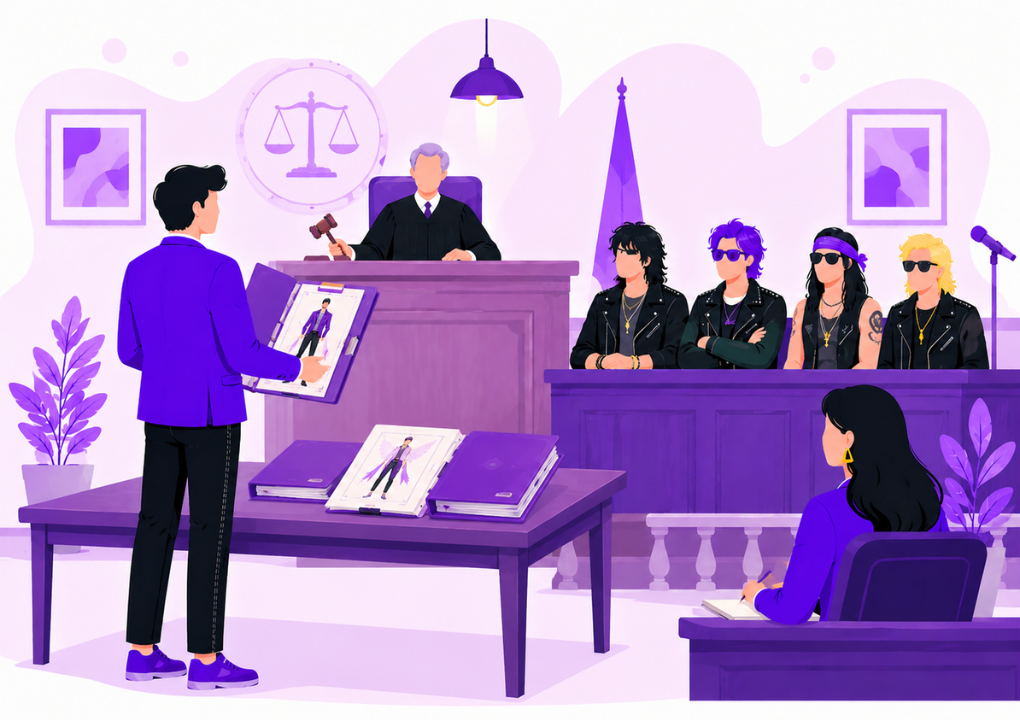
After two weeks of silence, Wright pushed for payment and found himself redirected to the band’s attorney instead. The attorney leaned on Wright’s perceived lack of resources, suggesting that taking a famous band to court would be a costly losing battle. Wright wasn’t persuaded. He had documentation for every stage of the project, signed confirmations at each payment milestone, and photographic proof that the band had worn and performed in the finished garments. Rather than threaten a costly lawsuit, he simply filed in small claims court — a venue designed for exactly this kind of dispute.
The Courthouse Standoff
On the day of the hearing, Wright arrived prepared with a briefcase of evidence: photos, sketches, fabric samples, and payment records — far more documentation than most people would think to bring into a small claims proceeding. The attorney, meanwhile, spent the wait shuttling between phone calls, projecting an air of importance and barely acknowledging Wright at first. Once he did approach, he leaned into a kind of practiced intimidation, asking pointedly whether Wright was sure he wanted to go through with it and warning that the case would be “tough” if it went forward.
Wright didn’t budge, and the two of them essentially sat in a standoff, watching the clock count down toward the hearing. When that intimidation tactic didn’t work, the attorney pivoted abruptly — just minutes before the case was set to be called — offering a check on the spot in exchange for a signed agreement stating the band had paid in full and the matter was resolved.
Wright agreed, on the condition that the amount was correct. Both parties walked into the courtroom together, told the judge they’d reached a settlement, and the case was dismissed within moments. Wright didn’t take any chances with the check, either — he drove straight from the courthouse to the bank it was drawn on and walked out with cash in hand, making sure there was no chance of it bouncing after everything he’d been through to get it.
Why Big Names Try These Tactics?
Morgan and Wright unpack why this kind of standoff happens so often with high-profile clients. Morgan suggests that large, wealthy clients sometimes deliberately hire smaller, independent contractors precisely because they’re easier to pressure than bigger firms with more leverage. Wright agrees, but notes that his existing reputation and client roster — including his work with Bacardi — meant he wasn’t desperate for the gig, which gave him more confidence to hold his ground and set firm terms from the start.
Both also point out the irony that the band’s attorney was only brought in after the fact. Wright had already met and built rapport with the band members directly, without any entourage or buffer, which made it much harder for a lawyer parachuting in afterward to intimidate him. As Wright puts it, the band had already “showed who they were” to him face-to-face, and no attorney could undo that first impression.
Behind the Seams: Designing for Musicians
The conversation shifts into a lighter, more technical discussion of costume design for performers. Wright explains that outfit quantity varies by client — some tours need five or six rotating looks, while others, like this band’s show, call for just one outfit. He also shares standout projects from his career, including a guitarist’s custom tour-themed outfits and a particularly creative Bacardi promotional campaign built around a “Fight for Your Right” boxing theme, complete with boxing-inspired skirts, tops, and robes for promotional staff.
Creativity Through Constraints
Morgan draws a parallel to a conversation he’d had with a chef friend, who said that creative constraints — like cooking for kosher vegan guests — force more interesting solutions than working without limits. Wright agrees wholeheartedly, comparing his own design process to a chef’s: both fields rely on deeply internalized rules about what pairs well with what, whether it’s colors and fabrics or flavors and textures, and creativity comes from recombining those rules in new ways.
Wright closes by sharing that his path into fashion wasn’t formal. He attended school for graphic design but ultimately dropped out, struggling with the coursework outside his creative strengths. His entry into fashion came purely from his natural ability to draw and visualize a finished garment before it existed — a gift he simply followed into a full design career.
The Takeaway
This episode is a reminder that group clients carry different risks than individual ones, that documentation is a freelancer’s best protection, and that intimidation tactics from attorneys often crumble the moment someone is actually prepared to go to court. It’s also a fun reminder that creative industries — whether fashion or food — thrive on constraints, internalized expertise, and the confidence to hold firm on fair terms.
