
From Corporate Success to Entrepreneurial Reality
In this episode of Client Horror Stories, Morgan Friedman welcomes business strategist and leadership consultant Trisha Daho, who shares one of the most valuable lessons of her entrepreneurial journey. Only six months after leaving a successful corporate career as a partner at a global firm, Trisha was eager to establish her own consulting business. Like many new entrepreneurs, she found herself balancing confidence in her expertise with the uncertainty of building a personal brand from scratch.
Her story demonstrates that technical expertise alone does not protect business owners from difficult clients. Experience, credentials, and intelligence matter, but recognizing unhealthy client relationships is an equally essential skill. Through one disastrous engagement, Trisha learned how ignoring early warning signs can damage a consultant’s reputation, waste valuable time, and create unnecessary stress. More importantly, she discovered that the right boundaries often matter more than winning another client.
A Client Who Needed Strategy but Rejected It
One of Trisha’s earliest clients owned a small interior design company with approximately fifteen employees. The owner hired Trisha to help improve business operations, strengthen internal processes, identify ideal customers, and build a sustainable growth strategy.
As part of her consulting process, Trisha interviewed the company’s employees. Nearly every employee pointed toward the same underlying issue: the owner herself was the company’s biggest obstacle. Although this immediately raised concerns, Trisha believed she could still help transform the business through thoughtful guidance and structured planning.
Her recommendations focused on strengthening the firm’s core interior design business before expanding into unrelated ventures. She encouraged the client to define her ideal customer, improve operational systems, and invest resources where they would produce measurable returns.
Instead of following this advice, the client became captivated by an extravagant new idea. She decided to launch an online luxury home products store selling extremely expensive decorative items while hosting a lavish launch party for wealthy friends and clients. Trisha strongly advised against the plan, explaining that it conflicted with the company’s strategy, exceeded its financial capacity, and lacked any evidence that customers would purchase such costly products.
The client ignored every recommendation.
An Expensive Failure Followed by Blame
The launch party reportedly cost more than $100,000. Despite the extravagant event, not a single guest purchased any products, and the online store generated virtually no sales in the following months.
Rather than accepting responsibility for her own decisions, the client shifted the blame. She began telling people throughout Chicago’s tightly connected business community that launching the online business had been Trisha’s idea.
For a new entrepreneur trying to establish credibility, this kind of public misinformation could have been devastating. Fortunately, the truth reached Trisha almost immediately through mutual professional connections.
Morgan Friedman highlights one of the episode’s earliest lessons: professional communities are much smaller than people realize. Gossip, reputation, and unethical behavior often travel quickly. Individuals who spread false information frequently underestimate how easily their actions become known.
Drawing a Firm Line
Although Trisha generally considered herself patient and accommodating, this situation crossed an unmistakable line.
The client had already demonstrated a pattern of disrespect. Instead of scheduling professional business meetings, she expected strategy sessions while getting manicures or socializing at clubs. These meetings frequently drifted away from business and toward discussions about her personal life, demonstrating how little value she placed on Trisha’s expertise and time.
After discovering the false accusations, Trisha decided enough was enough.
She personally delivered a cease-and-desist letter to the client’s office, instructing her to stop making defamatory statements about both Trisha and her company. She informed the client that any further false claims would result in legal action before immediately ending the business relationship.
Although uncomfortable, the decision became one of the most important moments in Trisha’s entrepreneurial career. It taught her that protecting a professional reputation sometimes requires decisive action rather than endless patience.
Recognizing the Yellow Flags Early
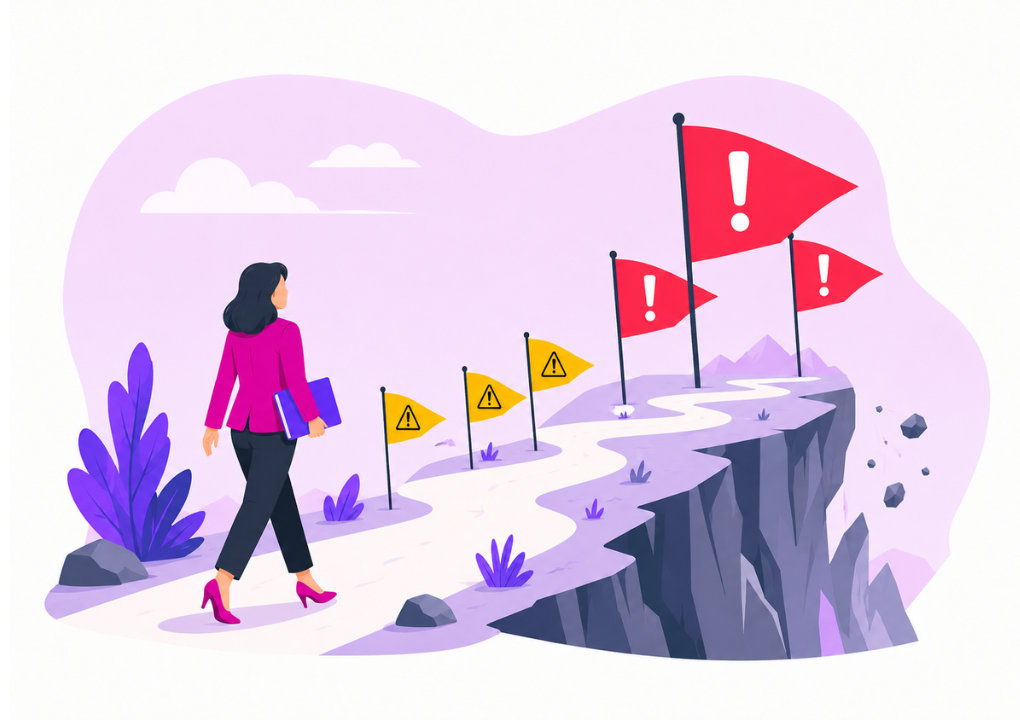
Morgan uses this experience to introduce one of the podcast’s recurring ideas: distinguishing between “yellow flags” and “red flags.”
Many professionals wait until a relationship becomes unbearable before ending it. Morgan argues that the better approach is recognizing smaller warning signs before they escalate into major problems.
The unusual meeting requests immediately stood out as one example. Conducting strategy sessions during manicures or social outings suggested that the client viewed consulting as something casual rather than a professional service deserving focused attention.
Morgan explains that clients who fail to respect a consultant’s time often fail to respect invoices, recommendations, or expertise as well. While any single incident might not justify ending the relationship, several small warning signs together often predict much larger problems ahead.
The Hidden Challenge of Being a People Pleaser
Trisha openly admits that her personality contributed to the situation.
Having spent years in corporate America, she had become accustomed to being constantly available for clients. Success often meant saying yes, solving every problem, and remaining accessible around the clock. Combined with perfectionist tendencies and a desire to satisfy others, this mindset made it difficult to recognize when a client was taking advantage of her.
Morgan expands on this insight by explaining that people pleasers require even stronger personal boundaries than others.
Someone naturally inclined to give clients the benefit of the doubt will often ignore multiple warning signs before accepting reality. Because of this tendency, Morgan suggests lowering the threshold for action. Instead of waiting for numerous problems to accumulate, people pleasers should begin reconsidering a relationship after only a couple of meaningful warning signs.
The conversation highlights an important psychological lesson: boundaries are not signs of selfishness but tools for protecting both professional effectiveness and personal well-being.
Three Rules for Choosing the Right Clients
The experience fundamentally changed how Trisha evaluated potential clients. Rather than accepting every opportunity that came her way, she developed three simple but powerful rules that every client must meet before working with her.
The first requirement is self-reflection. Trisha believes clients must be willing to examine their own behavior instead of automatically blaming others for every setback. Self-aware people are more open to feedback, more willing to change, and ultimately more likely to achieve meaningful results. They view consultants as partners rather than miracle workers expected to fix every problem while they remain unchanged.
The second rule is motivation. Trisha emphasizes that she cannot want success more than the client wants it. Genuine transformation only happens when clients are personally committed to improving their businesses. Without that commitment, consultants spend more time pushing reluctant clients than solving real problems.
Her third rule is the simplest and perhaps the most memorable: she refuses to work with people who consistently behave disrespectfully. Talent, wealth, or influence cannot compensate for poor character. Years of experience have taught her that protecting her team’s well-being is just as important as generating revenue.
Morgan agrees that these standards create healthier partnerships and notes that self-reflective clients rarely become defensive or assign blame when challenges arise. Instead, they focus on learning and improving together.
The Value of Blameless Problem Solving
One of the most insightful concepts introduced during the conversation is “blameless problem solving,” a leadership philosophy Trisha learned from the book Culture by Design. Rather than searching for someone to blame whenever problems occur, effective leaders focus on understanding what happened, identifying weaknesses in the process, and preventing similar issues in the future.
According to Trisha, leaders who practice blameless problem solving typically possess high emotional intelligence because they prioritize solutions over ego. They encourage honest conversations, create psychological safety within their teams, and foster continuous improvement instead of fear.
Morgan immediately embraces the concept, recognizing that many successful leaders naturally practice this mindset even if they have never heard the formal term. Both agree that organizations become significantly stronger when accountability replaces blame and curiosity replaces defensiveness.
When Business Decisions Become Ego Projects
The conversation returns to the extravagant launch party that started the client’s downfall. Morgan argues that poor business decisions happen to everyone. Every entrepreneur experiments with strategies that sometimes fail. However, decisions motivated primarily by ego deserve extra scrutiny.
The client’s decision to spend over $100,000 on an elaborate event was never supported by market research or financial logic. Instead, it appeared designed to impress wealthy friends rather than generate sustainable business growth.
Morgan introduces another useful “yellow flag.” When a business owner repeatedly chooses highly visible projects that feed personal ego instead of serving customers, consultants should pay close attention. Ego-driven decisions often signal deeper leadership issues that eventually affect every aspect of the business.
Trisha adds that service-based businesses have far less room to hide internal dysfunction. Since employees themselves represent the product, unhealthy leadership and toxic workplace culture quickly become visible to clients and employees alike.
Why Small Warning Signs Should Never Be Ignored
Throughout the discussion, Morgan repeatedly returns to the idea that most business disasters do not begin with obvious red flags. Instead, they develop from several seemingly harmless yellow flags that accumulate over time.
A client who schedules meetings during personal appointments, ignores expert advice, refuses accountability, shifts blame, and prioritizes ego may not seem impossible after the first incident. However, when these behaviors consistently appear together, they reveal a predictable pattern that consultants should not ignore.
For people with naturally accommodating personalities, Morgan argues that recognizing these patterns early is especially important. Waiting for absolute certainty often means waiting until significant financial or emotional damage has already occurred.
Standing Up for Professional Boundaries
After ending the relationship, Trisha discovered that the client still refused to pay her final invoice. Ironically, the company’s CFO privately acknowledged that Trisha had provided valuable work and later maintained a positive professional relationship with her. The former client even returned a small gift Trisha had given during a networking luncheon, an act clearly intended to make a final statement.
Instead of regretting her decision, Trisha viewed these actions as confirmation that ending the relationship had been the right choice. The client’s continued behavior reinforced everything she had already learned about toxic personalities and unhealthy business relationships.
Morgan observes that individuals who constantly yell, intimidate, or attempt to humiliate others often believe they are gaining authority. In reality, they usually achieve the opposite. Rather than inspiring respect, they encourage capable professionals to distance themselves as quickly as possible.
The discussion concludes with a broader reflection on today’s workplace. As communication increasingly shifts toward emails, messaging platforms, and AI-assisted writing, identifying difficult personalities may become more challenging. Polished messages can hide poor attitudes that would once have been obvious during face-to-face interactions. This makes careful observation, emotional intelligence, and strong professional boundaries more valuable than ever.
Conclusion
Trisha Daho’s experience serves as far more than a memorable client horror story. It is a practical guide for entrepreneurs, consultants, and business leaders learning to protect both their reputation and their peace of mind. Her journey demonstrates that successful client relationships depend on mutual respect, accountability, and shared commitment rather than simply signed contracts.
The episode reinforces several timeless lessons: trust your instincts when warning signs appear, establish clear boundaries before problems escalate, choose clients whose values align with your own, and focus on solving problems instead of assigning blame.
