
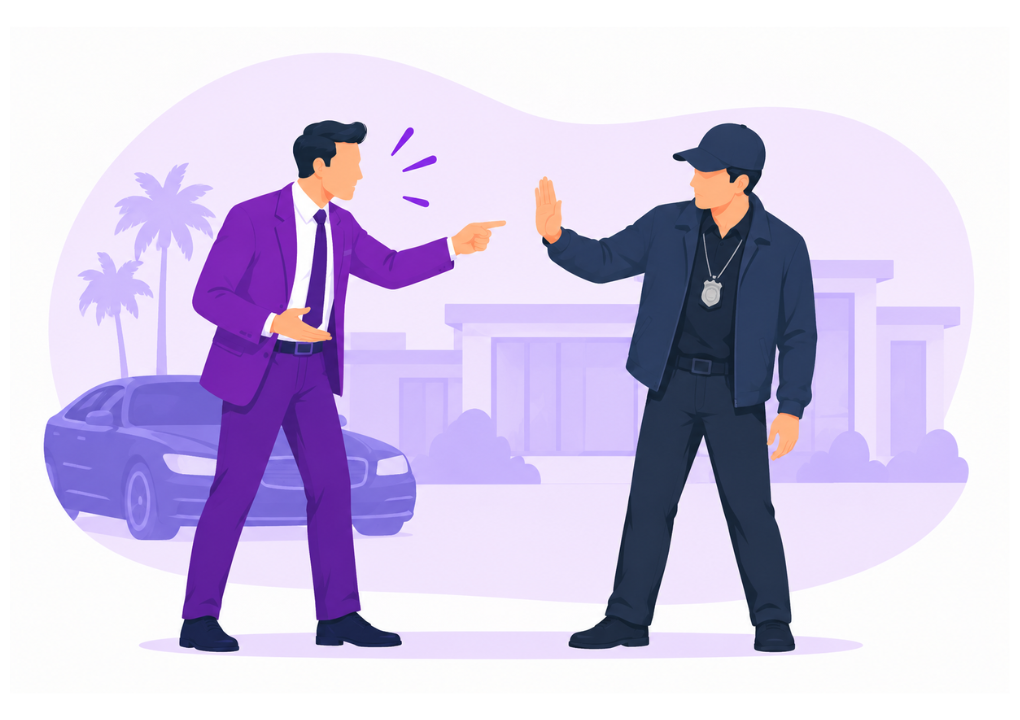
Morgan: Hello, hello, everyone! I’m especially excited for today’s episode of Client Horror Stories. Truth be told, I’ve never interviewed—or even met—a private investigator before. It’s so exciting to have the one and only Ken Childs with us today. How are you doing, Ken?
Ken: I’m well, thank you. Good morning.
Morgan: Good morning! I have my morning coffee with whiskey all prepared and ready, and I can’t wait to hear about your craziest client horror story. Take it away.
Ken: Okay, so this actually made nationwide news.
Morgan: Wow!
Ken: Yeah, no, it’s a big deal. It ended up involving a couple of arrests and six sheriff’s deputies.
Morgan: Wow. Before the story even starts, we’re already breaking records on this podcast!
Ken: Yeah, this is a no-joke, scorched-earth-style client. I learned a lot from this. I might need double the amount of whiskey today.
Morgan: I think I should pour some bourbon as well, now that we’ve started this.
Ken: Let’s pause it. I’m going to go get some booze!
Morgan: Let’s jump right in.
Ken: So, in 2021, I got this call. The guy seemed like a normal person at the time. He basically explained that he was a cryptocurrency guru and that somebody had stolen his laptop. He knew who had done it because of the circumstances, and he explained how he knew.
The thing was, he wanted to see whether this person still had the laptop. He wanted surveillance, and he was prepared to go all in: a full team, six months, a year—he didn’t care. However long it took, let’s just do it.
Morgan: Wow.
Ken: To me, I thought, okay, sadly, that’s not terribly far-fetched by Los Angeles standards. He was saying all the right things: “I have the money. I have the time. I have the patience. Let’s just go for it.”
So we did. We didn’t locate the person right away. Then he ended up having another team locate the person of interest.
Morgan: Wait, so he had the full works going with you, but he simultaneously had another team doing the same thing?
Ken: Law enforcement.
Morgan: Law enforcement. Got it, got it.
Ken: That’s what I mean by another team. And sadly, that’s what gave this individual more credibility with me.
I met with him in this Beverly Hills mansion. It was a $30 million mansion, and the whole situation was surreal. I was meeting with him and two or three sheriff’s deputies, so I was thinking, “Oh, okay. This is legitimate. It’s real.”
They then found the person of interest, so we started surveillance. I took a couple of retainers, and off we went.
Morgan: Great.
Ken: Fast-forward about a month. We eventually saw the laptop, the device itself. What happened was that another mystery person came over to our subject’s home. We could see them through the window. Both devices were connected, and they were typing away.
Morgan: By the way, I need to pause you because this really sounds like a Hollywood movie. You had one of your guys outside a window with some telescope-like device, looking in, and you saw the computer. Then you saw someone else come over and connect to it through the window?
Ken: Yes.
Morgan: Wow! This is a movie. I’m so excited!
Ken: Yeah. We could see the two devices, and they were clearly trying to hack our client’s device. So I explained what was going on to him. I said, “Hey, this is what’s happening.”
And this is where everything turned.
He suddenly said to me, “Okay, great. So when that other guy comes out, I want you to rob him.”
Morgan: No, no, no, no, no, no!
Ken: I’m not kidding.
Morgan: Wow! I just want to pause and say that, both in my life and over the course of the 100-plus episodes of Client Horror Stories, I’ve often heard about people asking others to break the law. Usually, it’s a subtle hint or an implication, leaving things unsaid. It’s incredible for someone to be so upfront and direct about it.
Ken: Just bold, right? It was like Dr. Jekyll and Mr. Hyde. I was dealing with this little emotional businessperson, and suddenly he showed his teeth.
He said, “I want you to take him. I want you to rob him the second he comes down. I want you to get him before he gets into his car and take his bag.”
Even revisiting the story, my mouth is open. At the time, my mouth was open, too.
I tried to backpedal and said, “Look, man, first off, we’re not in the robbery business. You’ve watched TV. We don’t do that. Second off, what the hell are you thinking?”
There are a whole list of reasons why it’s illegal. I’ll get in trouble. What are the chances I could even succeed? And so on.
Morgan: Yeah.
Ken: And not only that, the subject we were watching was an idiot who had a gun. Every time he left the house, he’d stick a gun in his belt and walk out the door. This guy was so out of his mind. He was his own movie character—a cartoon character of himself.
If I grabbed his buddy down below, he’d run to the balcony and start shooting down at us. None of this was good.
So I backpedaled, and I thought I’d calmed everything down. Okay, we’re not going to rob anybody tonight.
Now he wanted surveillance on another person, let’s call him Subject B. Fine. We started surveillance on Subject B.
The problem was that the retainer was exhausted, but things were moving fast because the client was getting anxious and angry. I was a little behind on collecting the retainers, and I didn’t want to bring it up while he was frothing at the mouth.
Morgan: I’m already loving this story. We’ve dealt with people not collecting retainers on time, or clients refusing to pay. But the twist here is the urgency of the situation. When you’re in a moment of urgency, it’s really hard to step back and say, “Hey, let’s discuss how much you’re paying me.”
Ken: Right. And money would come up periodically, but it wasn’t dire at first.
There’s also the problem that you’re sitting there thinking, “Well, this kid is worth a billion dollars. What does he care? He’ll pay. It shouldn’t be hard for him to get caught up.”
A couple of days went by. But think about it: not only was his retainer exhausted, things had ramped up exponentially. Now you’re looking at thousands of dollars a day. Within a couple of days, you’re suddenly talking about $30,000, $40,000, $50,000—just like that.
And while we were doing this, he had his other team doing more things behind the scenes that I wasn’t even aware of.
Morgan: The other team being the police?
Ken: The police. And then some other security guy who was supposedly ex-law enforcement. I don’t know for sure, but he was probably somebody who’d been fired because this client was a complete asshole. He had law enforcement connections and had no problem going up to other people’s houses and threatening them.
What the hell? But again, I didn’t know any of this was unfolding. We were just doing surveillance on Subjects A and B, and things were moving fast.
A couple of days later, Subject B became active, and we followed him. I was about ready to ask for the retainer because we were talking about a significant amount of money.
Then the client sent a goon—a big, muscular guy—down to the surveillance.
Morgan: No, no, no, no, no!
Ken: We called him MMA Mike.
Morgan: Well, that’s his name?
Ken: That’s his name. And he was a legitimate MMA fighter. I’m not a little dude. I’m six-foot-two and 200 pounds, but this guy would have made me his bitch. He was not a small dude. He was a professional fighter.
Suddenly, this guy showed up at the surveillance location. My team called me and said, “Who the hell is this guy? What is he doing here?”
And they were out. They were leaving the job. My team rolled off. They were split. They wanted their money, and they wanted out.
Morgan: Wait, so when you say this guy showed up, you mean he went to where the surveillance was taking place. Did he threaten them or say anything?
Ken: That came later as the night unfolded.
So here I am. I’ve got kids and a life, but nobody sees that side of business. I’m at home while my team’s working. My team is blowing up my phone, asking who this guy is and why he’s there. I’ve got the client blowing up my phone, asking what’s going on and why my team is leaving. And I’ve got kids at dinner-crunch time. I have a four-year-old, and they’re screaming because I can’t get their mac and cheese out fast enough.
I’m in this tailspin thinking, “Fuck, I don’t know what to do.”
Finally, I tell everybody to pump the brakes. I’ll be right there.
I get the kids fed, leave the house, and go flying to the location where MMA Mike is. I pull him around the corner and ask, “What are you doing? What the hell are you thinking?”
He’s literally talking in this broken, tough-guy language. “Boss say steal computer.”
Morgan: [Laughs.]
Ken: And I’m thinking, “What the hell? Why on earth? What are you thinking? You’re going to do jail time over a fucking laptop that you don’t even know is real, and you don’t understand what’s going on.”
So I try to paint a bigger picture for him.
I say, “Okay, here’s the situation. Guy B shows up at Guy A’s house with the laptop that’s supposedly worth $300 million to $700 million. You think the hacker just has the laptop, drives by, and hacks it while the guy we’re watching is there? No. The guy we’re watching has the laptop. Guy B shows up, and they play with it all day, trying to break into it.”
I tell him, “Guy B doesn’t have the laptop, you idiot! What the hell, dude?”
He literally puts his finger into my chest. He threatens me, although I forget exactly what he said.
At that moment, I switch into a different mindset. I’ve been doing surveillance my entire life. I think, “Okay, buddy. You’re not going to be able to sit in a car for 20 fucking minutes without catching butterflies or having to piss or whatever it is you need to do.”
So I’m like, “Fine, fine. We haven’t seen this guy active in about a week. It’s fine. Sit on the surveillance. Let’s do surveillance.”
And what do you know? My freaking luck. About half an hour to an hour later, Subject B comes out of the house, and there goes MMA Mike. He snatches the fucking computer.
Morgan: No, no, no, no, no!
Ken: The whole time, I’m just sitting there thinking, “How did I get here? How did this happen?”
It was all these small circumstances that I screwed up, and they ended up putting me in positions I couldn’t get out of. I couldn’t bail out at that point because I was owed a massive retainer, and I owed my team their money. I was watching everything go to shit right in front of me.
Anyway, Mike gets the laptop. They’re out of there, and we go back to the original client.
The guy hacks into the computer in about two minutes. He’s like a proud kid showing his dad something: “Here’s all the evidence!”
We’re looking at a black screen with green text, right out of The Matrix. This nerd is reading code to me: “This is my laptop here. This line of code means it was connected via USB. Here’s the date and time you saw it, so it was connected to my laptop. And here’s all the software they were using to brute-force it.”
I’m sitting there. I don’t hear a word he’s saying. I’m just thinking, “How do I get paid? How do I get paid?”
We’re owed a ton of money. Everything has gone sideways. I’m trying to backpedal and say, “Hell yeah, I’m so glad you did that! This is great!”
Meanwhile, I’m thinking, “How are you going to pay me?”
Morgan: [Laughs.]
Ken: We walk away from the surveillance and pump the brakes because, you know, you’ve robbed somebody.
I sit down with my partner, my brothers, and some other people, and I’m asking, “How do we get paid on this? This is bad.”
I’m hoping the client will want more surveillance so I can say, “Great, let’s get caught up, plus some.”
I take a vacation, a couple of days off. My wife’s losing her mind because this job is so intense.
While I’m on vacation, around 7:30 in the morning, I get a text. A buddy of mine sends me a clip from Channel 7 News.
They robbed the other guy.
They sent goons to the guy’s house. They kicked in the door, and shots were fired over that laptop.
Morgan: Wow!
Ken: I’m not kidding. The story keeps going, by the way. We’re not even at the peak yet. We’re near the top, but not quite there.
Morgan: We might be in for a world record of Client Horror Stories! At this point in the story, what was on the news? Did they get the laptop, or did you not know?
Ken: They didn’t get the laptop. Shots were fired. Subject A—the person we were surveilling—ended up shooting at the guys who kicked in the door.
Thank God I hadn’t just gone and robbed somebody myself, for many reasons.
Morgan: Freaking idiots!
Ken: So now I’m thinking, “I’m definitely not getting paid. They’ve canned the whole job. They’ve fucked everything up.”
I’m still messaging with the client, trying to say, “Okay, great. We’ll pump the brakes and start it back up in a month or two.”
What else can I tell this guy? “Hey, you just killed everything everybody’s been working toward. Why didn’t we slow-roll this for six or nine months and get law enforcement involved, like you said you wanted to do?”
But who wants to hear that? Obviously not this guy.
The job is over. He then tells me, flat-out, that I failed to perform.
I’m thinking, “What are you talking about? We did an amazing job for several weeks, maybe even two months, of undetected surveillance. We confirmed that it was your laptop. What do you want from us?”
He basically said that because I didn’t rob the guy, I failed to perform.
Morgan: Wow!
Ken: Therefore, he wasn’t going to pay me. At that point, I remember the amount was something like $50,000 or $90,000. In the blink of an eye, it got that high.
Morgan: Usually, at this point in the story, I ask questions like, “Well, was that in the contract?” I’m assuming there’s nowhere in the contract where you’re supposed to rob anyone.
Ken: That was our argument to him. Literally, review the contract. We explicitly state that we will not perform illegal activities. We’ll perform surveillance.
What did I need to do? Put it in brackets and list everything, including kidnapping, killing, and breaking and entering? I didn’t think I had to spell it out!
Morgan: People will interpret things to their advantage. It’s unclear whether robbing is illegal in this context, especially with the way everything’s going to shit today!
Ken: Exactly.
So now the job is over, and I’m not getting paid. I pay a couple of my investigators what I can. There were two investigators I wasn’t thrilled with because I felt they could have prevented everything from going to shit if they’d waited for me to calm things down with MMA Mike.
Anyway, I lost a bunch of relationships over this.
Now we’re at the end—or, rather, the beginning. The job is over, and we’re starting Part Two.
Morgan: The sequel strikes back!
Ken: Not even the sequel. It’s the never-ending goddamn client who would never quit.
So I’m talking to my attorney, and we send the client a notice to arbitrate because that’s what our contract requires. You have to follow your contracts, right?
I send the notice, and he actually accepts. His attorney, though, was worse than the client. I didn’t even think that was possible, but this guy was probably one of the ten biggest assholes in the world.
We get to the point where we’re negotiating. The client claims I’m withholding surveillance video and money, which I wasn’t.
So we use that to our advantage. We say, “Okay, if that’s what you think, set aside the $125,000 you owe us in a trust. We’ll give you all the videos and everything we have.”
I believe it turned out that he was just posturing. We weren’t actually going to get anywhere with arbitration. He wasn’t choosing a judge or moving forward. He was just stalling, stalling, stalling.
So we went ahead and sued him because that was ultimately where things were headed.
Before that, I spoke with my attorney and said, “Look, here’s the reality: I’m never going to see this money. What I’d like to do is write this lawsuit in a way that gets the attention of the district attorney’s office.”
Morgan: Interesting.
Ken: The reality was that I wasn’t going to get paid. The cool thing about a lawsuit—and I don’t know if people realize this—is that you can make allegations in it because that’s the basis of your lawsuit. You have to prove them, of course.
Morgan: I see. So the lawsuit goes on the public record, and you can make allegations because the whole point is to discover what’s true and what’s false.
Ken: Exactly. My lawsuit laid out what had unfolded and identified the players involved. That was my last attempt to go scorched earth because I knew I was screwed.
We’d just bought a house. I had babies. I owed my team a ton of money, and this guy had tanked everything. I was waiting for the day when I’d end up talking to law enforcement because the whole situation was out of control.
Morgan: I don’t know what’s coming next, but there are even stronger ways to do that. You make it public, and then you start getting media attention.
Ken: Well, I beat you to that one!
Morgan: I’m so excited!
Ken: What ended up happening was that, maybe six or nine months later, the attorneys were still posturing, and I was getting inundated with paperwork and responses.
But no, no, no. Here’s what happened.
I sued him, and he went full scorched earth on me.
We were in our new house, and these assholes—these savage crypto people—didn’t have jobs, but they had plenty of time to go online and pay for access to databases. They knew who they were dealing with. They knew who I was, where I lived, my phone numbers, my wife’s phone numbers, and her family.
My ex-client went completely nuts. There’s no other way to explain it.
My phone was going off all day with spoof calls. My wife’s phone was going off all day, too. She’s in education, basically a teacher, and she was getting spam calls constantly.
Finally, that night, my wife and I were sitting down to dinner, and we turned our phones off. We couldn’t even put them on silent and set our alarms for the next morning. We were like, “God damn it. This is too much.”
At around 5:30 in the morning, we heard pounding on the door.
I ran to the door, and it was my wife’s mother and father—my in-laws. They were pale, with all the color drained from their faces.
I was terrified for them. I said, “Come in. I don’t know what’s going on.”
They asked, “Where’s our daughter? Where’s our daughter?”
I told them to go to the bedroom and check on her. They ran in, saw that she was okay, and came back to the living room. We sat down and talked.
What had happened was that these crypto assholes had used spoof calling. A spoof call is when you pay for an app that lets you make a call appear to come from a different phone number. If you know my phone number, you can enter it into the app and then call somebody else. Their phone will display my number.
So my mother-in-law thought she was getting a private call from me.
Morgan: Right. She saw your number and sincerely thought you were calling her. She thought it was an emergency at 4:30 or 5:30 in the morning.
Ken: Yes. She picked up the phone, and there was a woman screaming in the background as if her life were coming to an end. She was screaming, and then they hung up.
Morgan: Imagine getting that call. The only thing you can think is the worst possible scenario.
Ken: They thought their daughter was being murdered. They came over to the house and beat the cops there.
We were having this discussion in the living room when, suddenly, all our phones started going off at the same time. Mine, my wife’s, my in-laws’—all of them.
Thankfully, by that point, it was obvious to everybody that these were just people going nuts. You can’t stop crazy.
That ended the first part of the morning.
Then I was on the phone with my attorney. I was also getting what I think were spoof calls from other people on the fringes of the situation. Looking back, I think these crypto assholes were trying to get more information out of me by pretending to be people who weren’t directly involved. They were trying to build trust and get information.
Morgan: By the way, I don’t know how long ago this was, but my instinct is that a modern version of this would use AI. You can imitate people’s voices with AI and pretend to be their daughter, saying even worse things.
Ken: Morgan, listen to you! No one’s going to mess with you after this podcast.
Morgan: [Laughs.]
Ken: You’re going to call my entire family! You’re going to AI their voices!
Anyway, I’m sitting in my home office talking to my attorney when I hear footsteps at the front door.
I get off the phone, and there are two sheriff’s deputies at my door with their guns drawn.
The client had spoof-called the sheriff’s deputies, too, making it sound as though a woman was being beaten in the background.
Thankfully, I live in an extremely quiet neighborhood. Also, I came out with my hands open, saying, “Hey, guys, whatever you need. This has been going crazy. Come on in. Whatever you need first, we’ll talk when you’re ready.”
At that point, they didn’t even need to see the house. I guess they spoke to the gardeners and realized nothing was going on. They came in, saw how I was talking to them, and understood that I was being straightforward.
That all ended, but within the next couple of days, the client did something else. And this is going to become a business tip when we wrap up.
He went into his phone, logged in, and reversed the credit card charges for the retainers he’d paid me.
Morgan: Ooh! Fifty thousand dollars gone in a blink.
Ken: Not only was I out the money he hadn’t paid me, but I was also out the money I’d paid my team. I’d just bought a house and moved into it during the beginning of this whole process, and I had kids to support.
Then he reversed the payments.
This is why nobody should do business with AMEX.
Morgan: By the way, last night I recorded an episode of Client Horror Stories about chargebacks and how easy it is for people with bad intentions to reverse a transaction. They can get their money back without anyone asking questions, and it’s incredibly difficult for vendors.
Ken: I’ve got a tip about that, because of all this. It’s the way you handle payments and the way you do business.
He did what’s called an AMEX reversal. When there’s no physical card involved, even if your contracts say you’re allowed to charge the client, AMEX doesn’t give a shit. They don’t care. The money is automatically reversed, and you’re left figuring out how to sue or what to do next.
Or just not kill yourself, because I was at the edge of the cliff.
Morgan: You said that’s an EMV reversal? Is that what you called it?
Ken: It’s either AMV or EMV. But what it is, is when you don’t have the physical card. When there’s no physical card, the transaction can be reversed.
Then, on top of that, he had a couple of payments that were wired to me. He went to JPMorgan Chase and told them that I’d somehow attempted to commit wire fraud, and that was how I’d ended up with the money.
That was another $50,000 or $60,000—or whatever the retainer was.
Morgan: Wow.
Ken: Then JPMorgan Chase communicated with Wells Fargo. Wells Fargo shut down all my banking without asking me any questions.
I banked exclusively with Wells Fargo. My personal bank accounts stopped working. My business accounts stopped working. My personal and business credit cards stopped working. Everything was frozen.
Morgan: So you literally couldn’t access the money you needed to pay for dinner the next day?
Ken: I had nothing. I had to go to a friend who worked at a bank and beg him to open a credit card for me without any money behind it. I told him I’d have to fund it in a week or two.
I got a credit card with no money. That was the only way I could pay for my kids’ Happy Meals and buy gas at that point.
Morgan: Wow!
Ken: A big “fuck you” and thank you to Wells Fargo. They wouldn’t honor our subpoenas. Neither would JPMorgan Chase.
Apparently, they’re above the law. They don’t care.
Morgan: Wow. You’re speechless.
Ken: Imagine how I felt!
We literally had an ongoing lawsuit. We’d issued subpoenas to Wells Fargo, my own bank, and to the other bank. Neither responded.
Morgan: Nothing?
Ken: Nothing. I think we eventually got a response that wasn’t exactly “go fuck yourself,” but it was essentially, “We’re not going to answer that.”
Morgan: Wow. And you’d been with them for 20 years, exclusively. You’d think that relationship would at least get you an explanation like, “Hey, I know this sucks, but here’s how things unfolded.”
Ken: Nothing.
Morgan: Wow.
Ken: Yep.
Morgan: At the beginning, you mentioned arrests. Before we get into the lessons, can you tell us how the story ended? Did anyone go to jail?
Ken: A few more months went by. There was legal paperwork back and forth. They were pretending to answer our interrogatories, and everybody was just bullshitting each other.
Thankfully, they made a bunch of mistakes during discovery, and that worked to my advantage.
Then, one day, I was driving, and my phone literally said “FBI.”
I thought, “Get out of here! This has to be more bullshit.”
I answered the phone, and I was pretty bold. I basically said, “Who is this? This is bullshit.”
The woman said, “I’m Special Agent So-and-So, and I’d like to talk to you about your lawsuit.”
I thought, “Yeah, right. My whole life has just been blown up. Everybody’s been spoofed. I got swatted. The whole thing.”
I was about to tell her to go pound sand and hang up.
Either I asked, or she suggested, “If you don’t believe me, hang up your phone, Google the FBI, call the Los Angeles field office, and ask to be connected to me.”
So I did. I hung up, Googled the FBI Los Angeles field office, called, went through the automated system, and asked to be connected to the agent.
Suddenly, I was talking to the same person.
Morgan: Wow! So it was real.
Ken: Yes. She introduced herself more formally and said, “I’d like to talk to you about your lawsuit. Do you have time?”
I said, “Yeah. What are you doing right now?”
Morgan: [Laughs.]
Ken: We met that day or the following day. We met at the Cheesecake Factory in Sherman Oaks.
I sat in a booth, trying to act as though I wasn’t ready to piss myself. I was asking to see her badge, as if I even knew what the hell I was looking at.
I saw the actual metal badge and the pistol on her hip, and I thought, “Oh, okay. I guess that’s pretty legitimate.”
Morgan: Right out of a movie!
Ken: Yep.
Morgan: Did anything come of the FBI investigation?
Ken: We spoke for a couple of hours. They recorded the conversation and asked questions. That was their version of a nice meeting.
A couple of weeks later, I got the not-so-nice, formal meeting. My attorney and I met with them again. There were three agents there, including the same lead agent, and they were not only recording but transcribing everything in real time as we talked.
Morgan: Wow!
Ken: Here’s the really wild part. I was sitting there, and they had daggers in their eyes. They wanted me. It was obvious they were pissed.
Morgan: Wait, they wanted you?
Ken: Yeah. Look at the situation. Here’s this nut job and what he’s done. I’m a private investigator, so they’re thinking, “Why was he involved in a robbery? How did this happen? A shooting has unfolded. Is he involved in a conspiracy, too?”
Morgan: I see. This is something I often train my teams on: when a situation is really dirty, it doesn’t matter how clean you are. You can look terrible just by being there.
Ken: Exactly.
Looking back, the thing that saved me the most was being very straightforward. I literally told them, “I cannot afford to be arrested and thrown into some conspiracy case. I will answer any and all questions you have. Period. I’m an open book.”
I’m not going to hide anything, because let’s face it: in that second meeting, you’re sitting in front of three of the smartest people you’ve probably ever met in your entire life.
The second they admonish you, the recording starts with something like, “In short, this is the FBI. If you lie to us, we will prosecute you.”
Morgan: So there’s that!
Ken: Exactly. I told them on the record, “I’m not getting tangled up in this. I can’t believe I’m even here. Whatever you need, ask me. I’m an open book. I don’t care how bad I look. Go for it.”
We spoke for another couple of hours.
Morgan: Wow. Did you ever find out what happened to MMA Mike? Did anyone go to jail?
Ken: The client who hired me was named Adam Iza. You can Google him. He’s been awaiting sentencing, according to what I know. There were also several sheriff’s deputies involved. The complaints against him are public records.
His girlfriend, Iris, was also part of the situation.
What happened was that the client made a mistake in one of the text messages he sent me. I hadn’t really cared about how he’d found the person we were investigating. I thought he was posturing and trying to impress me by saying something like, “We found him through a search warrant.”
I was thinking, “Whatever. I don’t really believe that.”
But in the screenshot he sent me, everything was redacted except one line at the bottom, where a female officer’s name appeared.
That’s what the FBI wanted to know about.
They showed me a bunch of photo lineups. I recognized one of the officers but didn’t know the others. Then, through some text messages that hadn’t been deleted or manipulated by the client, I was able to show them the other information I had.
I could say, “Yes, these were the cops. They were involved. We saw them. This is what took place.”
Morgan: Oh, shit!
Ken: I believe it was six sheriff’s deputies. We made the LA Times about three times. Six sheriff’s deputies were arrested, and Rolling Stone was going to do a story about all of this.
It made nationwide news a couple of times.
Morgan: Wow! And now it’s about to make Client Horror Stories as well.
First off, I’m amazed and impressed that you didn’t lose all your hair. Your hair might be white, but you still have it. You’re still here, standing strong. I know a lot of people who literally might not have been able to make it through that amount of stress.
Ken: I almost didn’t.
Morgan: Congratulations for surviving that. Let’s talk about the lessons you’ve learned. I’m sure there are so many. You can start by brain-dumping them on me.
Ken: Lots of lessons.
First, contracts don’t mean shit. Whatever you put in your contract, make it comfortable for you and specific to your area.
Let’s say I’m in Los Angeles. Have the contract detailed and Los Angeles-oriented, because the last thing you want is some asshole in Utah to yank you out to Utah.
But ultimately, contracts don’t mean anything when you’ve got awful attorneys who rip them to shreds, posture, or just delay things. So write it to your benefit and move on.
Second, don’t take AMEX. AMEX will literally allow people with black cards and better to open their app and decline a charge right there. Boom. You’re done.
Morgan: Quick question. Earlier, you were telling us about EMV transactions, when you don’t have the card physically. In your experience, is there a difference between a charge being challenged when the physical card was used and when it wasn’t? Or does it not matter?
Ken: It may not matter with that level of AMEX, but lower-tier cards have a challenge system. You can challenge the reversal, and I’ve always won those.
I’ve been able to submit emails, contracts, and a report showing the outcome. I can give them the whole story: “You want to reverse this charge? Here’s everything that happened.”
I’ve always won those, so it wasn’t on my radar.
But now, what I do to protect myself is use a payment system where the client enters their details through a payment link.
Most systems have this now. It costs a slightly higher percentage, but you can use something like QuickBooks. You enter your client’s details, send them a payment link, and they open it and enter their own payment information.
That way, they’ve entered their contact information and payment details themselves. It can help reduce the ability to reverse a transaction in the same way.
Morgan: I’ve paid my accountant and one of my lawyers through links their systems sent me. I enter the information myself. I hadn’t realized that by doing so, I might lose the ability to reverse the transaction. That’s a very interesting lesson for me.
Ken: That’s how I protect myself moving forward.
Another lesson is never to get behind on retainers, no matter who the client is.
This is where clients like this get you. The guy is living in a $30 million house. I’m meeting with him in his Lamborghini, and his girlfriend is driving a Rolls-Royce.
When everything looks easy, you convince yourself that they won’t back out of a payment. You think, “This is nothing to them.”
And it isn’t nothing to them. People can still be scumbags.
I got behind because I thought, “Why wouldn’t they pay? This amount is nothing to them.”
But the reality is that I should have said, “Hey, big guy, here’s where you stand.”
I’d fulfilled their needs. If this were a legitimate situation, they should have had no problem replenishing the retainer.
So never fall behind on a retainer again.
Another lesson: the second you realize you’re dealing with a bad client, bail.
You’re done. Wrap it up.
The second he said, “Hey, can you just rob this dude?” I should have said, “Well, you know what? About that…” and shut the whole thing down right there.
If I’d done that, I would have lost only an incremental amount of money. Maybe the lawsuits wouldn’t have happened. And don’t forget, lawsuits are expensive. I spent my personal money going after this guy.
Morgan: Excellent lessons.
One question. One of my favorite approaches is obsessing over identifying red-flag clients before even starting. Was there anything about his personality, his appearance, or those early meetings that, in retrospect, made you think, “No, no, no. He was like this from Meeting One, and I shouldn’t have taken the contract”?
Ken: No, and I think that’s where he got me. I sold myself on the situation.
There were a couple of moments involving foul language and posturing, but I’m also a dude. I don’t give a shit. Whatever.
I didn’t see anything so extraordinary that alarm bells went off.
That’s where I think he was so masterful, because I wasn’t the only person he did this to. In the first complaint filed when he was arrested, there was another person he’d screwed over. There was a huge party, and he apparently screwed over the party planner.
His sheriff’s deputies allegedly pulled the guy over, planted drugs on him, and got him arrested. The charges were later dismissed. It sounds like I got it bad, but that guy got it worse.
That’s all public information. The agent who filed charges against him initially filed one complaint, then amended it in a second complaint that included tax evasion allegations.
Morgan: Based only on what you’re describing, another possible red flag—even before you meet someone—might be a pattern I’ve noticed with people who have a lot of money but didn’t earn it.
I’m going to stereotype a little, and I hope our listeners don’t do the same. But I’ve noticed this pattern with people who get lucky with crypto or inherit a huge amount of money from their parents.
Not everyone, of course. There are exceptions. Everyone is different. But sometimes their value system is different because of how they acquired that money.
People who suddenly have huge amounts of money they didn’t earn can develop a messed-up value system that leads to very dark behavior.
Ken: Yeah, exactly. And that’s how they manipulate you, right? Because the money means nothing to them.
He literally told me, “Fuck you. I spend more than that on clothes during a shopping spree.”
That’s where his head was.
But he knew that amount was everything to me. I lost friends, colleagues, money, and banking access. I bounced checks. It ruined my life.
It was so bad that I literally thought to myself, “He’s going to do this to someone one day, and that person is going to kill him.”
Morgan: Or that person might kill themselves.
Ken: I mean, I was in a terrible place. I was maxed out. My wife was maxed out. I have no idea why my wife is still with me. Anybody else might have said, “Fuck you. I don’t want this drama.”
What saved me was one day when I was sitting with my little girl. She looked at me and could sense the stress. She put her little hand on my face and said, “I love you, Daddy.”
Morgan: Wow.
Ken: That’s why I didn’t do anything dark. Don’t think it didn’t cross my mind. I was maxed out.
Morgan: Wow. It really is a dark world out there.
Ken: That’s partly why I like telling this story, even though my wife doesn’t want me to tell it. It happened, and it can happen to you.
You can’t stop crazy. That’s a huge lesson I’ve learned. You cannot stop crazy.
Someone wants to nuke your life? They can do it.
Look at the idiot who’s currently suing me. Subject A. This guy is suing me. Instead of suing law enforcement for all the bad things that have happened—when some of those people are making plea deals and accepting prison time—he’s suing everybody under the sun and representing himself with some scumbag attorney.
Even now, I believe he’s the one going online and creating all these dramatic stories about me. It’s not terribly complicated to see what’s happening. He’s posting made-up stories and all this other stuff.
You can’t stop crazy. You can’t stop this level of stupidity.
Morgan: To summarize the lessons, here’s another one: even if you don’t have much money, have at least two bank accounts, with your money split between them.
Ken: I’m so glad you said that. When my bank accounts were drained, I was sitting there thinking, “God damn it, if I’d had a separate business account and another account, I could at least have pulled money out of the other one and kept operating my life and business.”
Morgan: Not just two accounts, but accounts at separate institutions.
As a metaphor for that, I’m security-paranoid myself. I don’t use everything through Google, as a lot of people do. Some people have their email, documents, and voice calls all through Google. I’m always worried that one thing could shut everything off.
So I use one platform for email, another for documents, and other platforms for voice calls. My bank is with one company, my credit card is with another, and so on.
That reduces the surface area of attack.
Ken: Yeah, I get that. I don’t operate that way, but I understand it. I don’t have the bandwidth for that. Even as a private investigator, I’m not that dark. I don’t constantly think, “Oh my God, people could do this.”
I’m just trying to keep a small business going and get back to where things used to be.
Morgan: And you still haven’t recovered?
Ken: I still haven’t recovered. That was in 2022 and 2023, and now it’s 2025, and I’m finally at the point where I can breathe and talk about it.
Morgan: When you’re attacked on so many fronts at the same time, it overwhelms you.
My practical side starts thinking about techniques: How do we minimize these risks and avoid this?
But my more spiritual side hears your story, and first, my heart goes out to you for the pain you went through. It also asks, “What lessons is the universe trying to teach you—and all our listeners?”
Apparently, there are a whole bunch.
As dark and painful as these experiences are, I say this to potential clients and callers: you can’t stop crazy.
And if you take that in at a deeper level, there may be something to gain from it.
You take a step back and reset. You can’t stop them. The reality is that some of this is just online bullshit. Who cares?
They’re calling you. Eventually, they may get bored. You get swatted? Come out with your hands up.
I’m not saying it doesn’t matter. I’m saying you can’t always stop it.
But if you can step back from it and become stronger, your threshold for pain the next time is significantly higher.
Ken: Exactly. If anybody came at me like this now, including with the current lawsuit, I’d think, “Oh, please.”
After what I’ve been through, I haven’t given two shits about this guy or his lawsuit. He’s online, posting all these made-up stories and dramatic readings about me, and all I can think is, “You’re an idiot.”
I focus on myself, my business, and moving forward. I don’t give a shit about all the other things.
I think that’s the strength I’ve gained from dealing with all of this. Now I can look at it with clarity.
That’s the problem with these lawsuits, hacks, and people who want to cause trouble. They convolute everything and disrupt your life.
If you’re able to step away, recognize that you can’t stop crazy, get back in your lane, and go back to work, that’s what will get you through it. That’s how you keep your business going and pay your bills.
If you go out into the fringes and get distracted by all of it, you’ll continue to lose more—not only what you’ve already lost, but more—because you’re distracted.
Morgan: That’s a great lesson. It’s sometimes simplified into the saying, “That which doesn’t kill you makes you stronger.”
You’re living proof of that. I feel like we all hear that saying when we’re kids and kind of ignore it, but it really is true in a deep way.
And it’s not just that. This is how you get better and better. By putting up with shit at higher and higher levels, you develop the tolerance to handle even more the next time.
Ken: Right. Imagine what gives me gray hair now. Please! I can handle it.
Morgan: [Laughs.] Wow.
With that amazing story, congratulations on surviving it, rebuilding, becoming stronger, and still having your hair!
Thank you for honoring us by telling your story.
Ken: Thank you for allowing me to share it and tell my story unedited.
Morgan: And to everyone who’s watched this episode and made it to the end, I hope you’ve learned as much from it as I have and found it as gripping as I did.
To be continued! Thank you again, Ken.
Ken: Thanks, Morgan!
