
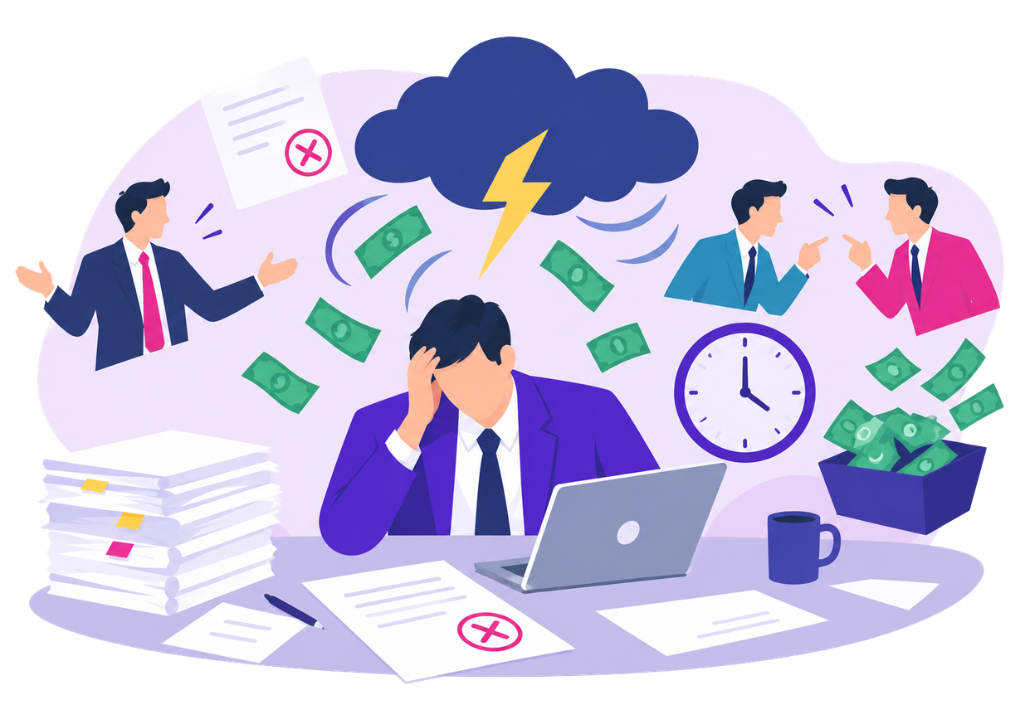
Morgan Friedman: Hello, hello everyone. Welcome to the latest episode of Client Horror Stories. I’m very excited to have the one and only Paul Sweeney with me today. How are you doing, Paul?
Paul Sweeney: Excellent. Excellent. Excited. Well, I don’t know if I’m excited to share my horror story, but I’m excited to be here. It could be a bit cathartic. Let’s see how it goes.
Morgan Friedman: Since these sessions tend to be alcohol-infused, what are you drinking today?
Paul Sweeney: Given the time of day, and the fact that we’ve spoken before about the Irish heritage, I’ve gone with the Kilkenny today. That’s what I’ll be consuming as we talk—or drowning my sorrows as I remember the horror of this experience.
Morgan Friedman: I love that intro. Let’s get right into the horror. Tell us about the story. I’m on the edge of my seat.
Paul Sweeney: I believe what’s probably the worst part about this—and I think a lot of people will go through this experience thinking, “I should have known better.”
My background is that I’m an accountant, and I was working with clients. I was actually in the transition between two businesses at the time, so I was probably a little bit distracted. I was leaving one business relationship and starting fresh myself.
I got caught up in doing something for a client that, when you sit back and think about how you should behave, how you should react, and what pre-vetting you should do, none of that actually happened.
I ended up on this fast-paced roller-coaster ride with a client I’d been dealing with for a number of years.
Morgan Friedman: I just want to interrupt for a second. The alcohol is already getting to me, which is great.
I love the saying, “Hindsight is 20/20.” Even when I look at my own mistakes, I’m like, “I can’t believe that wasn’t obvious to me.”
I think you just have to go through a lot of pain in order for the obvious to become obvious.
Paul Sweeney: Looking back, it’s so much easier. But at the time, I was thinking, “Okay, I’m starting this new business. This is a big opportunity.”
It was a big opportunity for a client. They were about to raise a lot of money, with a view to becoming a public company. There was a lot of opportunity, a lot of people, a lot of excitement, capital, and investors involved.
The urgency and timing were just not very good for me because I was in that transition phase. But they needed everything urgently.
They said, “Great, we want you to come on board and be our outsourced CFO. We want you to hit the ground running. You’ll get paid, and there’s a lot of money coming in.”
I thought, “Great. That’s fantastic. That sounds like just what I need when I’m starting a new business. I need this big injection of revenue.”
But then I thought, “Hang on. If I’m going to be spending all this time doing that, I’m going to need somebody else to work on my other clients.”
So I needed to hire somebody quickly.
I hired quickly, and things started going very fast.
I was already set up with new titles, email addresses, computers, and introductions. But there were a couple of core things missing.
There was no contract. There was no engagement letter.
They hadn’t got their HR systems right, either. They said, “Who do we know about HR?”
Morgan Friedman: I just want to comment on that. You’re starting your own business, and something I’ve found among entrepreneurs is that you tend to get so excited. You’re like, “Oh my God, this is going to be so much fun.”
You don’t step back to think about the full consequences.
It’s the other side of the coin, because it’s really beautiful to get excited. Only people who care less don’t get excited, and it’s great that you got so excited.
Paul Sweeney: I was excited. There was a dilemma.
Do I get an employment contract? That’s not really where I’m at. They hadn’t got their HR systems involved because they were waiting for me to advise them on that.
On the accounting-business side, I didn’t have my engagement letter ready to go. Part of it was that I was still in this transition, waiting for registrations and licensing to come through under the new business.
I was in this period where I was in between and not really able to fully act.
Unfortunately, because of the pace of things, I got caught up. I got swept up into this madness—or flurry of activity, as I’d describe it.
Everything had to be done urgently and quickly. A lot of things got rushed, including contracts.
Morgan Friedman: It’s hard to resist that. Even if you know, “Wait, we should sign a contract,” you’re thinking, “Oh my God, this is going to cause so many things to happen.”
You’re just so excited. Self-discipline is difficult.
Paul Sweeney: Particularly when you’ve known somebody for a long time. There is an element of trust there.
Again, hindsight is a dangerous thing.
Trust does not mean a written contract. The promise of a contract is not a contract. The promise of a sale is not a sale.
Morgan Friedman: That is an excellent point. The promise of a sale is not a sale.
Paul Sweeney: I was promised all these things, and everything looked fine. I was involved in meetings with senior executives and capital investors, providing information and so on.
Things started going well, but a few bits and pieces were missing from the equation.
It seemed almost like everybody was too keen to move forward. They’d all jumped on the train engine but forgotten to connect the carriages behind them.
That’s how fast we were keen to get going. Everybody was on board, full steam ahead, shoveling the coal, but we’d left the carriages at the station.
Somehow, we had to go back and get them.
It’s always harder to fix something after the event than to do it properly in the first place.
We found that mine was not the only contract missing. There were a number of verbal promises given in this arrangement that weren’t backed up by contracts.
All of a sudden, the warning bells started going.
“Hang on. What has everybody been promised here?”
I thought, “If everybody gets what they’ve been promised, we’re going to run out of money very quickly. We’re not even going to last three months.”
Everybody seemed to think they had been promised this great package, but the cash flow didn’t match what everybody had been promised.
With nobody having contracts, cracks started to appear.
Conversations began getting heated.
“Why are you getting that? I was promised this. I should be doing this. I should have been in that meeting. Why are you not there?”
I was brought in from the outside. I felt like I was brought in after the event.
I always think that if I’m there at the beginning, I can advise people on the right path. But I was coming in while everything was already running very fast.
The engine had left the station, but the carriages were still there, and we were trying to put everything back together.
Morgan Friedman: I can imagine this situation being either malicious or incompetent. The people involved could be taking advantage of everyone, or they could simply not be adding up the numbers and thinking things through.
How would you balance it in this situation?
Paul Sweeney: I would say that, at the beginning, everybody had very good intentions.
But as soon as something doesn’t go right, that’s when people’s true character starts to come to the surface.
A couple of the parties involved had been brought in for their respective skill sets, but they didn’t see eye to eye on a lot of things.
When they didn’t see eye to eye, things started to get heated. The disagreements became more public, and they started involving other people.
Other people began thinking, “Hang on, where’s my piece of the pie? Why isn’t this happening to me? Why am I not getting this benefit? I haven’t actually been paid yet. What’s going on?”
Morgan Friedman: So people had different promises and different expected compensation. Some were getting paid now, some later, and when people became uncomfortable, they made it public.
Then everyone realized, “Wait a minute. He’s getting this. How come I’m not?”
That escalated everything even more.
Paul Sweeney: Absolutely.
It became obvious very quickly that the necessary steps at the beginning had been completely ignored.
Everybody got excited about raising money and launching the product, but they didn’t do the basic steps.
They had moved forward too quickly, and we had to go backward to get the legal structure fixed.
And who wins out of that situation?
Certainly not the client. The lawyers.
The lawyers were being paid, and all of a sudden I was looking at their bills thinking, “That’s a lot of money for something that could have been avoided at the beginning.”
It was also a lot of money for the amount of capital available to us.
Something had to change.
There were cracks forming. People were disagreeing. There were legal issues because the structure hadn’t been set up correctly or in the right order.
Accountability was going astray. There were arguments about who was responsible for what.
Then we started bringing in more people because we needed to increase the sales force.
That sounds great. A new company needs sales.
But they didn’t have the product ready to sell.
The product wasn’t ready, but they had already committed to hiring additional people. They had signed contracts with the new salespeople.
The new salespeople had contracts, but the original team didn’t.
The blame started to escalate.
“Who’s responsible? Why isn’t this happening? You’re not doing this fast enough because you’re spending your time doing that. You promised this to these people.”
Before long, the attention started turning to me.
“You’re the money guy. You’re the accountant.”
I said, “Yes, I am, but I can’t make money appear out of nowhere.”
You have a limited source of funds. You’ve promised the world to everybody—five times what you have available—and you haven’t sold a single product yet.
In fact, you don’t even have a product to sell.
Why have you run ahead and done all this?
Morgan Friedman: This realization clearly didn’t happen overnight. It happened piece by piece as you opened your eyes to what was happening.
As you realized it, did you make it clear to the CEO? Someone had to be in charge.
Paul Sweeney: I did.
But here’s the other issue.
The CEO—the guy who founded the company, came up with the idea, and had the knowledge behind the product—had appointed somebody else who also thought they were the CEO.
So we had two people believing they were the CEO of the company, both trying to make decisions.
Morgan Friedman: How does that happen? How could that not be clear?
Paul Sweeney: From where I was standing, it was very clear who the actual CEO was.
But some of the promises and discussions that we weren’t involved in positioned the other person as being more important.
I’ve seen this multiple times since, and I’m probably more aware of it now.
A second person, or a junior business partner, goes to meetings and represents themselves to the customer as the CEO because it makes them feel more important.
They want to give the perception that they’re the decision-maker, that the customer should be dealing with them rather than the other person.
We had a bit of that going on as well.
Morgan Friedman: So there was one person who was clearly the CEO, but a junior partner with some power represented himself as being more important than he was.
That created tension and confusion.
Paul Sweeney: Exactly.
We had the real CEO off doing his role, and we had the pretend CEO causing problems with other team members.
They were also developing a product, but they had skipped steps in the hiring and firing process.
I remember they had an issue with one of the hires, and he just disappeared.
Someone was hired, and then he stopped turning up to the office.
Eventually, they tracked him down. He was doing some work on his laptop from home.
I asked, “Who’s supervising him, and what does he have access to?”
They said, “He has access to our source code and our product.”
I said, “How have you not controlled this?”
All these basic processes had been skipped because of the excitement of getting the sale, getting the product, and getting the funding.
Fortunately, they were able to retrieve everything, so they didn’t lose anything.
But most businesses go many years before they have that kind of issue with an employee. They had it within the first three months.
And, of course, when an incident like that happens, who’s to blame?
The blame game started escalating in what was already a fractured working environment.
Who was responsible? Was it the IT person, the security person, the risk person, the general manager, or the CEO?
We decided we needed to get legal involved again.
Morgan Friedman: More legal bills.
Paul Sweeney: More legal bills.
It was not a great environment.
I will say that everybody involved at the beginning was well-intentioned. Nobody was malicious.
But it’s very easy for behavior to change when things start to go wrong. Strong relationships can disappear or fracture very quickly.
Unless there’s a guideline or framework established early on, you can’t write the rules as you’re policing the brawl that’s going on.
You just can’t do that.
It was almost a textbook example of what not to do when starting a company.
You could present it as a university or business course and say, “Here are all the things that could go wrong.”
People would say, “But they’re not going to happen.”
Well, they did happen.
Pretty much every single thing happened in this business.
Morgan Friedman: In the online security world, there’s a concept called the Swiss cheese model of security. Do you know that one?
Paul Sweeney: No. Please enlighten me.
Morgan Friedman: You know Swiss cheese, where you have a slice of cheese with holes in it?
The Swiss cheese model says that you make a system secure by having multiple protective layers.
Think of one slice of Swiss cheese as one protective layer. There will always be a hole in it.
But if you line up different slices of Swiss cheese one after another, the randomly placed holes on each slice are very unlikely to line up.
Even if there’s a hole in one layer, the hole in the layer behind it will be somewhere else.
You’ll always have some protection.
If you have 50 slices of Swiss cheese, there’s a one-in-a-bazillion chance that all the holes will line up at the same time.
Paul Sweeney: I think there was a lot of haphazard fixing—placing layers of cheese on top to try to patch a hole.
But if you think about 50 layers of cheese, that’s a lot of cheese.
If you could do one layer correctly, you wouldn’t need as much cheese, and it would be much easier to manage.
Things got out of control very quickly.
Morgan Friedman: So, getting back to you.
You had no employment contract, and nobody had agreed on your actual responsibilities.
Had you been paid at this point?
Paul Sweeney: No, I hadn’t been paid.
The decision was, “Is he an employee, or is he providing services through his business?”
I agreed that I was providing services through my business as a contracted CFO.
But I was still waiting for licensing to come through. I couldn’t invoice through my business because it wasn’t registered yet as an accounting business.
In the meantime, I was paying newly hired employees to run my new business and look after my other clients.
Less income was coming in because my time was diverted to this large client.
I was supervising a new employee, which is not always easy when you’re away from the office for significant hours and days working for another client.
You’re not supervising as well, and you’re not training as well.
Then, of course, there was the cost of paying somebody full-time.
The hire was based on the assumption that we would have this large injection of income from this client to kickstart the business.
We didn’t get it for quite some time.
The fractured environment continued, and the hostility started escalating.
The junior partner—the pretend CEO—and the actual CEO had disagreements about how much work was available for me and what I should be doing.
They questioned whether they really needed somebody providing that service, or whether they could outsource it to a bookkeeper or accountant and get less work done at a much lower rate.
Unfortunately, the real CEO lost that argument.
They decided they wanted somebody independent of him because I had a relationship with the CEO that went back many years.
They said, “We want somebody independent of you doing this work.”
So they cut back my work significantly.
Morgan Friedman: The only reason you were willing to go so long without money and without a contract in this disastrous situation was because there was a trusted relationship.
But that was the exact thing that was used against you.
They said, “We need a neutral outsider who doesn’t have that relationship.”
If it weren’t for the trust relationship, you wouldn’t have done all that free work for so long.
Paul Sweeney: Absolutely not.
We would have said, “We haven’t been paid. We’re not doing anything more until we get paid.”
But because of the trust and the relationship, and because the revenue model was going to be quite lumpy, I continued.
It was frustrating because we weren’t being paid in a timely way for the work we were doing.
Then, all of a sudden, the work was pulled from under us.
They asked me to help interview my replacement.
I said, “Okay, I’ll help. What kind of person are you expecting?”
They gave me a list of responsibilities.
I said, “We could still be doing that for you. I don’t see how that’s a problem.”
But they wanted somebody independent.
I asked, “What’s your budget?”
They said, “I think $1,000 a month.”
I said, “You’re going to be paying at least $5,000 to $10,000 for somebody independent to do the work you’ve described.”
The first three interviews were all around that ballpark.
So we were back to the same position.
We didn’t have the funds to pay for that person. We didn’t have the funds to pay me because we had spent it all on salespeople who weren’t making any sales.
We were running out of cash.
Morgan Friedman: What should you do?
Paul Sweeney: Fire everybody who isn’t contributing to sales.
Get rid of the people who aren’t producing income. Stop spending money, and actually produce the product.
Produce the product and make a sale.
Morgan Friedman: I love that advice.
There’s an old saying that’s mostly forgotten, but I use it all the time:
“When you’re stuck at the bottom of a well, the first thing you do is stop digging.”
You’re running out of money. The first thing you do is stop spending money.
Paul Sweeney: Exactly.
You’re not digging your way out. You’re digging yourself further in.
But that didn’t sit well because there were a lot of relationships involved.
Nobody wants to be told they’re not running their business well.
Suddenly, I was the enemy because I was telling them that what they were doing wasn’t working.
They didn’t want to hear that.
We had come full circle, and we still hadn’t been paid.
Morgan Friedman: How long had the whole story been going on by that point?
Paul Sweeney: Probably three or four months.
I think I ended up getting paid after about six months.
There were administrative issues about who had access to the bank account and who could approve payments.
They had a system where people were assigned responsibility for approving payments, and then they fired those people a month later.
We had to go through the whole process again.
It took a long time for me to get paid.
Eventually, they appointed a new independent chairman of the board. He had been appointed by the investors.
He came in, looked at the situation, and we had a frank discussion.
He said, “That’s just not good enough. We’ll get you paid. We’ll get this fixed up. What can you still do for us in the meantime?”
Morgan Friedman: Oh my goodness.
Paul Sweeney: The last thing you should be doing when setting up a business is working without a contract.
You shouldn’t pin your hopes on one big client.
The promise of a sale is not a sale. A sale is not good unless the money is in the bank and you’ve made a profit.
There were a lot of things going on.
You need to get the scope agreed, make sure everybody agrees before you start, establish what you’re going to be doing, how you’re going to get paid, and what your rate is.
There were so many things.
It’s easy for me to look back and say my mindset wasn’t really there because I was in transition between two businesses.
But I should have known better. I should have known a lot better about this.
Morgan Friedman: How old were you at the time?
Paul Sweeney: I would have been about 42.
Morgan Friedman: At 42, you should have known better.
Paul Sweeney: Yes, I should have known. Plus, that’s what I advise people on.
There’s a saying that the builder has the worst house in the street, the architect never finishes their own house, and the plumber always has the leaking toilet.
Morgan Friedman: The version I’ve always heard is that the shoemaker’s children go shoeless.
Paul Sweeney: Exactly.
Looking back, there are a lot of lessons to be learned and shared.
What I’ve discovered is that I can keep sharing these lessons with clients, and people look at me and say, “How is that possible?”
But I see these things repeated over and over in different businesses that I work with and advise.
It’s almost like people don’t want to learn from other people’s mistakes or experiences. They need to experience those mistakes and have their own horror stories before they can identify that something wasn’t a great move.
We don’t like to listen.
I think males over the age of 50 have a real problem with this. We don’t like being told there’s a better way to do things than our own way.
If you can learn from other people’s mistakes, you’re going to save yourself a lot of trouble, heartache, and financial problems.
Morgan Friedman: Sounds like an advertisement for Client Horror Stories.
Paul Sweeney: That’s the point of the podcast.
Morgan Friedman: One question I have is that I’m intrigued by the fact that you were 42.
In my mind, I was imagining you as a 25-year-old kid just starting out, where all of this would have been more explainable.
But you were 42, experienced, and advising people on these issues.
What was going through your mind? Why did you throw all the knowledge and wisdom you already had out the window?
Paul Sweeney: We’re looking at around 2015.
We probably weren’t as overregulated as we are now as an industry. These days, we can’t seem to move without signing a piece of paper and providing a urine sample and a retina scan.
Things were not quite as strict around engagements, contracts, and trust.
When you’ve been working with a client for 15 years, you know how they operate.
But when you take that person and move them into another environment, with a lot of other influences, and introduce a pile of money, things change.
Also, he was no longer the singular decision-maker.
That whole thing changed.
I probably didn’t adjust my thinking. I was in between two businesses, and the business I left ended on bad terms. I had a significant falling-out with my business partner.
I probably wasn’t thinking straight.
Like a lot of business owners, I was thinking, “I’ve got a base of revenue, but I need to grow it. Here’s a great way to do it.”
I didn’t think through it calmly and sensibly. I just thought, “I’ve got to get this up and running quickly. Here’s a fast track.”
Generally, if it smells too good to be true, it usually is too good to be true.
Morgan Friedman: One lesson hidden in all this is that it’s interesting how malls are designed.
I’m from the United States, and I love malls. In the classic mall model, there are two huge stores at each end, with lots of little stores in the middle.
You have two anchor clients because if one of them goes under, you still have one huge client to pay the rent.
A good lesson here is to make sure you have at least two anchor clients, not one.
Paul Sweeney: Absolutely.
I would say that no more than 30% of your revenue should come from one client.
We see so many businesses that rely heavily on one client. I’ve seen too many where 80% or 85% of their revenue comes from one client.
In the building and trades industries, a builder they’re contracting to can go into liquidation. Suddenly, they’ve lost 85% or 90% of their income.
Even government contracts aren’t always reliable. A change of government can mean you lose your contract very quickly.
I’ve seen that happen as well.
Morgan Friedman: What ever happened to this company?
Paul Sweeney: It’s still there. It’s a public company.
Morgan Friedman: If it’s still around as a public company, they must have done something right.
Paul Sweeney: They changed a lot of personnel.
Probably less than 5% of the original people are still there.
They diversified their revenue sources, employed people independently, brought in people with the right experience and sales experience, and focused on actually creating a product and selling it.
They stopped having everybody manage their own little piece of turf.
People had been thinking, “This is great. We’ve got a public company, and I’ve got a piece of the pie,” without actually doing the work to make it successful.
Morgan Friedman: A way I characterize the difference between doing things in Washington, DC, versus Silicon Valley is that, in DC, everyone is trying to make their share of the pie as big as possible.
The Silicon Valley way of thinking is, “How do we make the pie bigger for everyone?”
I’m very much a Silicon Valley guy. I can’t stand fights over your own little turf.
It makes much more sense to say, “How do we make everyone rich?”
Paul Sweeney: Absolutely.
The accounting industry in Australia has moved away from that old way of thinking.
Instead of saying there’s a limited number of clients and asking how we can protect our own share, we’re asking how we can make businesses work better.
If a business is more profitable, there’s more revenue to go around for everybody.
We all have different skill sets, so let’s work with each other and get the best result for our clients and business owners.
That’s something we’re seeing more of.
Business owners benefit from it.
In the traditional model, you might have a partnership of ten people, but they’re ten little individual castles within the business, fighting with each other.
Someone says, “I don’t want you working on my client because that’s my client. I don’t want you getting involved because they’ll start wanting to deal with you, and I’ll lose that revenue.”
Now we’re seeing more collaboration around what’s best for the client.
As you said, make a bigger pie, and everybody gets a bigger share.
Morgan Friedman: This was quite an adventure.
There were so many issues happening all at the same time. It was the perfect storm, where all the different problems came together.
Paul Sweeney: It wasn’t just one thing. It was a collection of calamities, a collection of failure points in the process—or a complete lack of process.
A whole bunch of things came together to create the perfect storm.
It wasn’t a great environment, but we’re on the other side of it now.
Morgan Friedman: I expected you to end by saying the company went under.
But it’s still public. There’s an interesting lesson there that if you have a good enough product or vision, you can survive all these disasters.
Paul Sweeney: I think the other key thing was that they changed the personnel, direction, and strategy.
They finally identified that there were issues and took measures to mitigate them and move forward.
Without that, they definitely would have gone under.
Morgan Friedman: Better late than never.
Paul Sweeney: Yes, but unfortunately, not everybody gets that chance. Not everybody gets that much time to fix things.
Morgan Friedman: Paul, there have been so many interesting lessons here. I enjoyed the story.
Thank you for showing up in your early morning and sharing this story with all of us.
Paul Sweeney: You’re welcome. It’s been good to tell it. I’m not too emotionally scarred from reliving it.
Hopefully, somebody will learn from this story and not make the same mistakes.
Morgan Friedman: I think there are a few important lessons.
The first is the Swiss cheese model. People often think that it’s a low probability that all the things will go wrong, but the perfect storm does happen.
The other lesson is that you were 42. The shoemaker’s children go shoeless.
You need to be careful even when you’re the expert.
Paul Sweeney: Absolutely.
Morgan Friedman: I think part of the shoemaker’s-children-go-shoeless phenomenon is that when you’re really good at something, it’s your instinct to be relaxed about it.
You think, “I do this all day long. I know how it goes.”
I’ve seen marketers do this. I’m a digital marketer, and I’ve seen marketers say, “I know how to write ad campaigns on Instagram. I’m so good. It’s fine.”
They do it in two seconds without putting the love and care into it, and then the campaign goes terribly.
Paul Sweeney: We see that with website people all the time.
They make great websites for other clients, but they haven’t updated their own website in five or six years.
Morgan Friedman: Exactly.
When you’re the shoemaker, you need to doubly make sure that your own shoes are awesome.
Paul Sweeney: Absolutely.
Morgan Friedman: Thank you, Paul. And thank you to everyone who’s watched until the end.
We hope you’ve enjoyed it as much as we’ve enjoyed recording it.
Until next time.
