
Morgan Friedman: Hey everybody, welcome to the latest Client Horror Stories. I’m very excited to have the one and only Kate Viana with us tonight. Did I pronounce your name correctly?
Kate Viana: Yep. Viana.
Morgan Friedman: Gold star. Yes, with gold star in one hand and my whiskey in the other hand. I’m excited to hear your story. Let’s go. So, tell us about your craziest client horror story.
Kate Viana: Okay. Yeah, I guess we’ll just jump in. So, this happened, I don’t know, three years ago now, I think. So, I had just started—I left a nonprofit in 2021 after they lost funding due to COVID, and I kind of went out on my own trying to do marketing, social media, things like that for other nonprofits around the United States.
And I actually had a lot of interest from around the United States, not just where I am, which is in Atlanta. And one client in particular reached out from Texas, and I was very excited because it was a cause that I’m very, very passionate about. I had a lot of volunteer experience with it. And so, I was just delighted that I would get to work very closely with this particular client.
I engaged with him around, I guess, maybe July of 2021. Everything went super well. The more we worked together, the better our relationship got. I began doing extra things. I started doing their newsletter, for example. I was editing some video footage for them.
And so, eventually they said, “Oh, we have, you know, this website and it’s absolutely terrible. Can you take a look at it?”
I said, “Sure.”
So, I look at their website, confirmed it looked terrible. It was like some GeoCities monstrosity from a very long time ago. And so, I said, you know, I’m not a website designer. I’m not. But I would be happy to, you know, give it a shot. I can do, if nothing else, you know, some drag-and-drop something that would be a vast improvement on what they have.
So, I used my personal GoDaddy account to build the website on WordPress and turned it over. And when I say turned it over, I mean I gave them a login to the site.
At this point, I was so kind of invested with the client that, you know, I was like, “Whatever I can do, you know, to help. I just want to do that because I want to help your cause. I want to feel like I’m contributing to the work that you’re doing.”
And so, in the end, I didn’t even charge—
Morgan Friedman: I want to add in a little insight. I don’t know where this story is going, but I know since we’re on Client Horror Stories, it’s going to turn into a horror of some sort. But you made an interesting comment that I just want to expand on.
You’re like, well, times were good, things were going great. I just gave them access to everything. And it’s so easy to forget—and this is a good lesson for all of our listeners—that it’s when times are good that you should document, prepare, be clear. You should prepare for the problems when times are good, because when shit hits the fan, it’s often too late.
Kate Viana: Yeah, I agree with that. Yes. Many lessons learned from this particular client experience, for sure.
Morgan Friedman: But yeah, so—sorry to interrupt. Now, times were good. You gave them access?
Kate Viana: Yes, I gave them access, and things continued. Like, I ended up not even charging them for the website because they were still kind of getting up and running. They had only been in business—or they were operational—since like 2019.
So, I thought, you know, this is something that I can contribute and feel really good about. So, they never paid for the website, which was fine. I didn’t care.
And I continued to make edits to the site, I don’t know, several times a month. So, it was not an insignificant amount of work, right, on top of all the designing and everything that I’d already done.
I guess about a year goes by and I decide, you know what, I want to branch out. I want to start doing some consulting in other areas, which is now what I do, which is culture consulting.
And I reached out to the client and I said, “Hey, I’m trying this new thing. What if I fly out there and, you know, on my own dime and I just kind of get some practice?”
This is a terrible idea, by the way. Never do this. Never, never, ever do this. I learned that the hard way.
But anyway, I flew out there. It was kind of in a remote area, so it was not a fun travel experience either.
Morgan Friedman: Just on your point, never do this. Still not knowing the harm and not knowing what happens—just on your point, never do this on the philosophical level, not even knowing what’s going to happen in your story.
I want to observe that a challenge of giving away anything for free is that, by definition, the other side won’t value it.
Kate Viana: Won’t value it. Yes.
Morgan Friedman: So, like, literally, hey, I’ll pay zero for this.
Kate Viana: Okay. It’s worth zero dollars to them.
Morgan Friedman: And then if they don’t value it, then it makes it hard for them to take it seriously.
Kate Viana: Yeah. Yeah. And to that point, I think, you know, also I am, which you can probably deduce from what I’ve just told you, I am someone who wants to give. Like, I want to do things for people and causes and whatnot that I really care about. And so, yeah, just—I want to. I just really want to give.
And I have been taken advantage of a time or two.
Morgan Friedman: So, you fly out on your own time?
Kate Viana: Yes. Yes, I did. Flew out there. It was okay at first. So, they were very kind enough to pick me up from the airport. They took me to dinner, and at the dinner was where I started getting the first inkling that this was not about to go the way that I wanted it to go.
We get to the restaurant and it’s myself, the executive director, some other members of the leadership team, and a couple of their other employees.
And when I tell you this, immediately I thought we were going to talk about, you know, how the visit was going to go. Immediately it just became kind of a—
And they were just talking about how much they couldn’t stand this employee or that volunteer or this board member.
Morgan Friedman: And I was not about you. It was just—
Kate Viana: Not about me. It was just like, oh, not about me. No, complaining about the organization in general.
Yes. And they would say, “Oh, you know, Susie is”—you know, that’s a made-up name, obviously—”but Susie is so awful for this reason.” And then they would turn to me and say, “Oh, you’ll meet Susie tomorrow, don’t worry, and you’ll see how awful she is.”
And I’m sitting there like a deer in headlights because I’m thinking, “This is my first in-person meeting with these people. I’ve been talking to them over text. We’ve texted, we’ve emailed, we’ve talked on the phone for, you know, a couple years now.” And this feels like it’s coming out of nowhere to me.
It crossed my mind that maybe they were like pranking me, but I thought that’s too bizarre. Why would you do that? So, I just decided to roll with it.
Morgan Friedman: Actually, I don’t—what I want to understand—I’m sorry. I got lost. End of a long day for me.
Kate Viana: No worries.
Morgan Friedman: So, they’re bitching, but like so much. You think they might be pranking you, but like, I—maybe because I grew up, I’m a New York Jew. I grew up surrounded by New York Jews where normal conversation is a—
So, I hear lots of people sitting around, including people you don’t know, complaining about everything. To me, that just sounds like a Thursday.
Kate Viana: So, well, if we had been—like, I do that with my personal friends, obviously. Everyone does that. But these are, you know, for all intents and purposes, strangers to me. I haven’t met them in person, and we’ve only ever discussed things like, you know, “Change this photo on the website,” or, you know, so this is my first introduction to them in person.
Morgan Friedman: So, it went immediately from years of having a very formal professional relationship to, from one second to the next, acting like you’re their best friend and thus complaining, dirty, ugly—all the dirty laundry. So, you’re like, what is happening here?
Kate Viana: Yes. Yeah. It was bizarre, to say the least, but, yeah. I just kind of ate my dinner and was like, “Okay, I guess we’ll see where this is going to go.”
We finish up dinner. I go to my hotel and open up my laptop, and I have gotten some more responses from the survey that I had sent out before I left to all their staff.
And this is just—it’s something that I’ve refined a lot by now, and I send it out to clients in advance and have their staff fill it out. And it just asks about the culture, about the internal communications, you know, how are things, how do they feel, how do you feel, how are you able to bring up issues or whatever, things like that.
So, nothing super crazy. More survey responses are trickling in as I’m sitting on my laptop and I’m looking at the responses coming in, and everything is, you know, one, terrible, poor.
“It’s a nightmare here. Like, I don’t know what to do. Everyone’s always crying.”
And I am sitting in my hotel room thinking, what have I just walked into? This is completely bananas.
But, you know, let me try to keep an open mind because again, you know, people’s perspectives are different, and some people can think, you know, it’s persecution if you, you know, aren’t allowed to drink coffee while you’re doing surgery. I don’t know.
But so, everyone’s different, right?
Anyway, so I get there the next day. It is exactly as bad as the survey responses indicated that it would be.
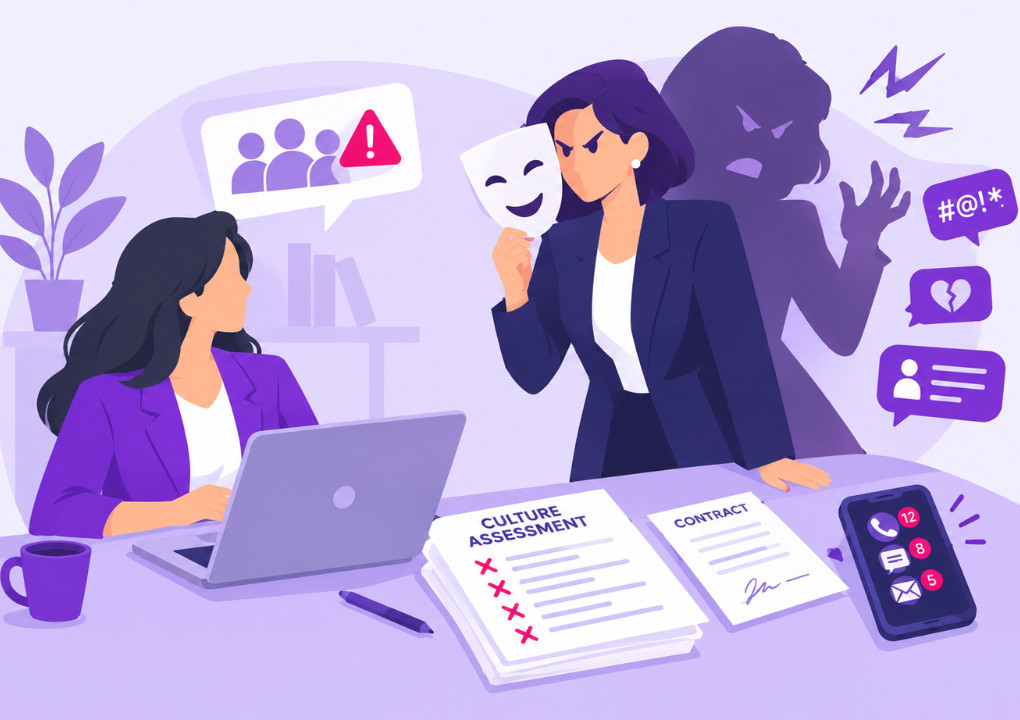
The executive director, a person that I had worked with very happily for a couple years up to that point, was a monster. Did not try to hide it. Screaming in the faces of their employees, name-calling, cursing.
And this is just in front of the employees. So, they had people coming in, you know, some—their people that they were providing services to. They had people regularly coming into the building to, you know, seek services, ask questions, whatever.
And it was like a switch flipped. She would go from screaming and being incredibly hateful and cruel to all smiles, all professional. I mean, it was a little bit creepy to see.
Never mentions this to me. I’m sitting there thinking, “This is insanity. Like, this person is maybe off their rocker a little bit.”
But I spend most of the day walking around observing this terrible behavior, or sitting in her office where she has this huge bulletin board full of things, full of little placards that say, “No one gives a shit about you. You need to work harder.”
And I think these are supposed to be like motivational quotes for people, but it was just—it was just crazy. It was just absolutely wild.
I had some—I did three employee group interviews throughout the day, and in all three, I’m not exaggerating, in all three at least one person broke down crying because the atmosphere was just so terrible and abusive and everything.
So, I’m shocked. I’m floored. I’m realizing that I was naive.
Morgan Friedman: You know, I did not actually know that this person that I was dealing with—you know, I made some assumptions that were obviously—
So, actually, it’s worth articulating some of those assumptions.
One of those assumptions is that the way they treat you will be the same way they treat everyone else.
Kate Viana: Yes.
Morgan Friedman: So, and I think that’s really important to call out because I feel like that’s a very normal human instinct. So-and-so is always a sweetheart to me. Therefore, so-and-so is just a sweetheart. And, like, that’s it.
Kate Viana: Yes.
Morgan Friedman: And unfortunately, humans are much more complex than that. So, so-and-so always being a sweetheart to you does not translate at all to so-and-so being a sweetheart in general.
Kate Viana: Right. Or to others.
Morgan Friedman: Exactly. Yeah.
Kate Viana: And that was very eye-opening, for sure, and just how quickly people can change based on their environment, you know, who they’re around, whatever.
So, anyway, get through that absolutely terrible couple of days of observation and interviewing, and I’m so grateful that I get to leave.
And again, very naively, I think to myself, okay, you know, this is an opportunity for me to provide some honest feedback on what I observed and, you know, was told. And, you know, I feel like I can really, really help this organization.
I’m laughing now as I think about my mindset back then. But I was thinking, you know, I can help, and I—I love this. I really want to help. I want to make this better because I care so much about the cause, right?
I get back to Atlanta, a couple weeks go by, and I complete their report—the report on what, you know, what I observed, what I heard, my recommendations, you know, next steps, all that—and I send it off.
And I don’t think anything else about it. An experienced consultant will be able to point out like at least three mistakes I just made, but I learned them. I learned them later.
But I guess about a week goes by. It’s a Sunday morning. I am off getting breakfast or something, and I get an email from the executive director that says, “We don’t want to work with you anymore. You are—you know, what this report that you submitted is basically full of lies. How could you say such damaging and, you know, obviously false things about us?” And, you know, we’re done, effective immediately.
And I wrote back pretty quickly because I’m accustomed to people saying things like that, like, “You know, I want to terminate the relationship,” or whatever. That’s not unusual.
So, I was disappointed, but I thought, okay, you know, it happens. Maybe funding ran out or whatever. This is what they’re hiding behind, basically. So, whatever.
Morgan Friedman: Yes, yes, yes.
Kate Viana: And I wrote back and I said, “Oh, you know, I’m sorry to hear that, but we’ve had a good run and, you know, I wish you all the best and, you know, whatever. Farewell.”
And I really thought that that was the end of it.
But that was just the beginning. And this is where the real horror story starts.
Morgan Friedman: The real horror story starts now. Dude, you should be a screenwriter.
Kate Viana: Just as I thought. I’m like, “Oh, this is going to be a short episode. Okay, this is terrible.”
Morgan Friedman: This is where the fun is beginning.
Kate Viana: Yes, the fun.
So, yeah, I didn’t hear anything from them for, I don’t know, another couple weeks, and I think whatever, you know, I send my final invoice and, you know, everything rocks along.
Then I get, out of nowhere, an email from—I cannot even remember this person’s name now—but they said, “Hi, you know, I’ve been retained by such-and-such organization.” Retained to take over their website.
And I said, “Oh, okay, cool. Well, go for it. You know, it’s all yours.”
And they said, “Well, you know, you have the login.”
And I said, “No, you know, the executive director has login. Like, you have control of it. It’s fine.”
And they said, “No, well, what we need you to do is…” and they proceeded to outline this incredibly lengthy list of tasks that they needed me to do in order to fully transfer the site over to them.
And it wasn’t actually that complex, but—and so I wrote back and said, “We don’t actually have to do this. I can just, you know, download the site. I can send it to you like as a Drive link or something, and then, you know, we can go from there. I can take it off my GoDaddy account and everything will be fine.”
No, no, no. They insisted, you know, I needed to do this, that, and the other.
And I said, “Well, okay. I mean, if that’s what you want, I can do that once you, you know, pay the final invoice.”
Because it was still out there, and it wasn’t a massive amount of money, but, you know, I wanted to be paid.
Morgan Friedman: Yeah.
Kate Viana: So, anyway, they refuse. Basically, the executive director, who was the one that, you know, quote-unquote fired me to begin with, gets in touch and is immediately like, “You’re being a—You are, you know, stop treating us like this. All we asked was for you to do A, B, C, D, E, F, G.”
I mean, there was so much that she was asking me to do, and she would not accept or believe, I guess—I think she thought I was trying to take advantage or something. She would not accept that, like, all you have to do is this very simple process.
She kept saying, “No, you’re wrong. No, you’re wrong. No, you’re wrong.”
And I said, “Well, you know, executive director, you haven’t even paid me. So, you know, like, what’s the problem? I’m like, if you pay me, then, you know, then we can move forward and we can figure out a way to get through this.”
Anyway, at this point, she starts going to my social media profiles, my personal social media profiles, and making unhinged comments.
Morgan Friedman: This is the executive director herself.
Kate Viana: Executive director. Yes. Yes. Being absolutely unhinged.
And I had forgotten—I don’t get on Facebook for my personal stuff very much, so I had forgotten that we were even Facebook friends. But she goes on, I don’t even know, like my last 12 posts or something, and is commenting like, you know, “You’re a liar, you’re a cheat, you’re a thief,” all this.
And I’m sitting there going, “What is happening?”
So, I’m, you know, deleting the comments, deleting the emails as they come in, which is full of more, like, you know, abuse.
And then she starts—she gets on LinkedIn, where I post obviously professional stuff, and starts saying, you know, “Don’t work with Kate. She’s a terrible person,” basically, and, you know, “Don’t work with her.”
And all this time I’m thinking, okay, the best thing for me to do is not engage, right? Because I’ve told you what you need to do in order for me to work with you here is just pay the last invoice.
And it wasn’t even that much money. I don’t think it was—it was less than $500.
Morgan Friedman: Yeah, nothing that was going to put anyone on the street.
Kate Viana: Right. Right. So, yeah, so I’m not engaging.
Meanwhile, I’m deleting all her comments. I’m also fielding crazy text messages and a barrage of phone calls from every number, and they all have, you know, a Texas area code.
So, I’m like, this is very obvious to me that this is, you know, this person that’s constantly calling, constantly calling.
Morgan Friedman: Finally, so the executive director was calling and calling from different phone numbers, I guess?
Kate Viana: Yeah. Yeah. And it took me—I don’t even know, like an hour to delete all the voicemails and the text messages.
And she had some of their board members contact me, and some other members of the leadership team reached out, and I was just—Anyway, it was bizarre.
But finally there was silence for about a week, and I thought, “Okay, is she going to pay me and then we can be done with this?”
No. She has her dad reach out.
And her dad was—this woman, she was at least 50. She had her dad, maybe a 70-ish-year-old guy, reach out.
I guess he reaches out and says—this is in an email, you know—”Hey, my daughter realizes that she’s been crazy. Can you help us? She’s really sorry. And, you know, can we go from there?”
And I write back and I go, “Hey, Dad, you know, I’ve told her to pay the invoice and then we can proceed with wrapping everything up. But, you know, I’m not just going to be abused and just pay you to abuse me, basically, you know, or, you know, take my time to help you figure this out when you’ve been so awful to me.”
And he doesn’t respond.
Another week goes by, don’t really hear anything.
And then another Sunday morning, I wake up to 10 messages from co-workers at the job that I currently had because I had gone back, like, I don’t know, a year and a half earlier, and I had said, you know, let me go ahead and get another full-time job for health insurance and, you know, some other things as well.
I had about 10 emails from my boss and her boss and several of my co-workers that they were forwarding me emails from the woman in Texas.
And she was saying, “Kate is, you know, you need to persuade her to do the right thing. She has stolen this from us. She has consistently been a source of headache and nightmare.”
Just, you know, just running me down in every possible way that she could think of.
And none of the stuff she was saying was true.
Morgan Friedman: Right. Right. She was sounding crazy. I mean, to read it, it sounds like the ravings of a crazy person.
Your boss and your boss’s boss—
Kate Viana: Yes. interpreted it as a crazy woman.
Well, they didn’t really say anything about it. They both forwarded me the messages and said, “What’s going on?”
Which at that point was kind of a turning point for me because before I’m thinking, you know, I can ignore anyone, right?
But now you are coming for my job, basically, right? You are attacking my livelihood and you’re basically, you know, just—what’s the word? Slandering me to, you know, to my colleagues.
And it was crazy.
I wrote back. I was so embarrassed, just absolutely humiliated and mortified at the time to get all these emails just on a random Sunday morning with, you know, all these terrible things being said about me that I know aren’t true.
But, you know, I don’t know my boss and, you know, her boss personally. So, it’s not like they could say, well, it could be true. You know, we know who she is as a colleague, but not as a person.
So, I write back so embarrassed, and I have to say, “I’m so sorry. This is, you know, one of my clients that I—the work I do on the side, and I’ll deal with it. I’m really sorry.” Whatever.
She had gone on my LinkedIn and found out where I was working at the time and just picked all the emails off of the organization’s website and just emailed everyone.
And I was blown away. I was blown away at the depths this woman was stooping to.
It was crazy. Like, I can’t just say, “Oh, okay, you got me. I’m going to give you the site.” You know, I’m not a pushover, right? And I don’t want her to think she can bully me into submission.
Morgan Friedman: Oh, the story is going to get fun now. Well, how does Kate Viana fight back?
Kate Viana: Well, you know, I thought it was not even really worth fighting over, but she sent me one final email that said, “We’ve retained an attorney and we are prepared.”
And mind you, now I’m in Georgia. They’re in Texas.
So, you know, “We’ve retained an attorney and the So-and-So County Sheriff’s Office is prepared to press charges against you for theft of services.”
She called it theft of services. I think she just pulled that out of the dictionary because that was not related at all to what was going on.
“Theft of services, and they are, you know, preparing to liaise with the Atlanta Police Department to have you arrested,” like, imminently.
And it was crazy.
And then I got, like, I don’t know, I think it was the same day or maybe the next day, I got a call from someone who was like, “Is this Kate Viana?”
“Yes, it is.”
“This is Sergeant, you know, Joe Smith.”
Morgan Friedman: Joe Smith.
Kate Viana: Joe Smith from the Atlanta Police Department, and, you know, we’ve got a warrant for your arrest for theft of services.”
And of course, at this point, I’m like, this is truly—I feel like I’m in the Twilight Zone. This is an entire jungle’s worth of bananas. Like, what is happening?
Morgan Friedman: Seriously, jungle’s worth of bananas. It’s crazy, that phrase.
Kate Viana: Yeah. Well, go for it.
Morgan Friedman: Go for it.
Kate Viana: But, you know, at this point, I thought, okay, she is crazy. She does not have a leg to stand on, but at the same time, I need to make sure that I’m covered.
So, I reached out—one of my best friends, her husband is an attorney here in Georgia, and I sent him everything. And I said, you know, you tell me, what do I do?
And he was like, she’s a crazy person. Like, she is so—he said, she has pushed it to the point that you could sue her for, you know, seriously.
Morgan Friedman: Well, you know, civilians can’t press charges, but you could pursue charges for, like, harassment, for slander, for all of this, because she is—you have obvious, clear evidence that she’s saying things that are demonstrably untrue.
Kate Viana: So, I said, well, God, I don’t want to deal with that. I don’t want to be dealing with her any more than I absolutely have to.
Morgan Friedman: Before I hear what happens next, to backtrack for a second, I’m intrigued by the sheriff’s call. It took a surprising twist.
I thought, like, when the way you said it, I was like, “This sounded fake.”
Do they get confirmation? Like, was it actually a real sheriff?
Kate Viana: Oh, no. It wasn’t real. It wasn’t real at all. Like, because that’s not—I mean, I could tell on the call that it wasn’t real, you know, because, I mean, you know, I’m just a person off the street. Like, you can’t call—I couldn’t call someone and be like, “Hi, this is Sergeant Kate Viana,” and I don’t know what to say.
And it was clear that this person didn’t know what to say either.
And plus, I don’t think the cops give you a heads up that you’re about to be arrested. They just do it.
Morgan Friedman: Police would never call to say there’s a warrant. They just would show up at the door with a warrant.
Kate Viana: Right. Exactly. So, yeah, it was super off-putting and it was silly, but it was also just like, I have had it with this absolute nutcase.
So, the rest of the story, I guess, is maybe a little underwhelming because I asked my friend’s husband, like, “What should I do? I don’t want to push this any further legally. I just want to be done with her.”
And he said, “You should give her the site.”
And I said, “I’ve tried to do that. She says that’s not acceptable. She wants more and more and more.”
And he said, “Well, here’s what you do. Email her, CC her dad, CC her website person, you know, everyone that has ever been part of this correspondence. Download the site and send it to them and then delete it from your GoDaddy account.”
And I said, “Fine, I can do that.”
So, I download the site, I get ready to send it, and I am not making this up. It was crazy timing.
As I am getting ready to push send in my email, the payment for my last invoice comes in.
Morgan Friedman: I was—
Kate Viana: Yeah.
Morgan Friedman: And I was like, “Oh, that’s all you had to do, dude.”
Kate Viana: Like, you have to just pay me. That is crazy timing. It was bizarre.
And I thought, “Wow.” Okay. So, I pushed—I pressed send, ended up having to go back and forth with the website person like three more times because they couldn’t figure out how to—I don’t know what they were trying to do, but I was just trying to get it over with.
She sent me one last—the executive director sent me one last super hateful email saying that, you know, I had destroyed their organization. I had just, you know, crippled their fundraising efforts and, you know, anything bad that happened basically ever for the rest of civilization is my fault because I’m just that terrible.
And up to that point, I had been like, I’m not going to respond. I’m not going to engage.
But I had to because I was like, you know what? She paid me. I have nothing to lose here.
And so I responded. I didn’t act crazy. I said, “Your behavior will damage your organization more than anything I could ever do would ever would.”
Morgan Friedman: You should have said—
Kate Viana: You have absolutely just blown up your organization because you are a terrible leader. You’re an abusive person. You have anger issues.
Morgan Friedman: I didn’t say all that.
Kate Viana: I just said that what you’re doing is more damaging than anything I could do on social media or something like that.
And I didn’t hear from her again, but then I started getting a bunch of views on LinkedIn on my LinkedIn profile from her husband, and I was like, “Go away. What’s wrong with you people?”
Ended up having to block her husband, too.
Thankfully, have not heard anything from them since then.
But interestingly, a few of their employees reached out, I don’t know, over the following months and were saying like, “Thank you so much. You were the first person to ever listen to us. We just really felt heard, and, you know, we all feel trapped because the job market isn’t that great out here.”
And I thought, what is happening in this organization?
Because I probably only saw the tip of the iceberg.
Morgan Friedman: Wow. Okay. This is a great story with lots of twists and turns and an unexpected one.
Kate Viana: Yeah.
Morgan Friedman: The heart of the story is dealing with crazy. One lesson is there are just some insane people out there.
Kate Viana: Yes.
Morgan Friedman: Another lesson is even when you’ve worked with someone, you can’t tell if they’re insane because you had worked with her for years.
Kate Viana: Mhm.
Morgan Friedman: It’s come up in previous episodes where you just take on a client, you don’t know them, and then it turns out they’re insane.
Here’s the various interesting twists in your story: you had already worked together.
Kate Viana: Yeah.
Morgan Friedman: And it’s really powerful. Like, working with them in one capacity, you do not really know them. And that is an important lesson.
Kate Viana: It’s very important. And I think for me and people like me who work specifically and exclusively with nonprofits, it was, you know, it was upsetting in the sense that this is really disturbing my peace.
I don’t appreciate being, you know, her telling lies about me or, you know, harassing me through email.
But it was also kind of disillusioning, right?
Because you think of the nonprofit world as a place that attracts at least people that aren’t terrible, you know, at bare minimum. And if you are engaged in missions and causes that exist to help others, then you must—I mean, I had always assumed you must not be, you know, the worst person in the world.
You must be a pretty decent person if that’s what you want to do with your life.
But that’s not true.
Morgan Friedman: So, something that I’ve noticed in my life is—and this might sound cynical and not nice. I’m sorry to the universe—that often the higher the stakes, the more serious and, like, not insane people are.
And, like, to say the converse, the lower the stakes, often the more insane people are.
Because what happens if something really, really, really important is at stake? Like, will the whole world blow up?
Guess what? If the whole world is going to blow up, the key people are going to get in a room and have this serious, focused conversation.
“Okay. Okay. No, no. We need to make sure the whole world doesn’t blow up tonight. Like, how do we stop that?”
And there isn’t a millisecond to just waste on—
Kate Viana: No.
Morgan Friedman: Well, you did. But as soon as the stakes get lower and lower and lower, guess what? They’re so low. Who the freak cares?
Kate Viana: Yeah.
Morgan Friedman: And therefore, people’s full insanity comes out.
Kate Viana: Yeah, I think I agree with that. And it’s a shame because I think what it stems from is they’ve got this little bit of power, right?
You know, I’m the executive director of this little nonprofit. You know, but I’m in charge. I’m at the top of this organization. I make decisions about who stays and who goes.
And they just kind of get drunk off that power, and they feel that they’re a very big fish in a very small pond. But all they can see is that they’re a big fish, and they just kind of get drunk off that power.
Morgan Friedman: I feel like if I had to name this—I’ll pretend I’m a psychologist now—I would call this the bouncer effect.
Because a younger Morgan, when I go out—when I would go out at night, like the bouncer is someone that has a tiny, tiny, tiny speck of power for these few hours tonight. Can have the absolute full authority, decisions to say, “You can come in. You cannot come in.”
And guess what? Being drunk on that little ounce of power, like you have the smallest, smallest perceived slight, you know, your chance of getting in is gone.
Kate Viana: Yeah.
Morgan Friedman: Let’s dive into this for another minute. I find this having the stakes being so small and people getting drunk off the power fascinating. Important topic and one that hasn’t really come up.
So, we’ve gotten two new lessons in today’s episode. I try to get in at least one new lesson in every episode.
Question: Have you changed how you do things in your processes, your way of working with people? So, tell me about how you’ve changed in order to detect and/or avoid these sorts of disasters in the future.
Kate Viana: I mean, I think what you were saying is true. You can’t ever really know someone, you know?
I mean, there obviously are, like, married couples out there who find out that their spouse is an axe murderer or something. So, you can’t—maybe you can’t ever fully know someone.
For my purposes, it’s more—it’s less about detection and more about just keeping things professional and protecting myself with, you know, signed, enforceable agreements, taking deposits upfront, never working for free ever.
Because, as you said, as soon as you give something away for free, it’s devalued. It’s immediately, you know, the person says, “This is worth what I pay for it,” right?
And so, if I don’t—if I don’t like it, I can just throw it in the trash, you know, figuratively or literally.
So, you know, yeah, nowadays I turn down people who don’t know what they want or who come across as needy, I guess.
And I don’t mind working with people who need a lot of guidance and help because that’s a big part of what I do, is guiding people towards, you know, better culture, better communication practices.
But, for example, if I work with someone who says, “Hey, while you’re doing this cultural assessment, can you also find out, you know, who took the brownies from the break room because no one will admit to it and we really need to know?”
So, if they’re needy in that sense, like they want to tack things on or they want to bring in issues that aren’t really that important, or, you know, it tells me their priorities—our priorities—are not aligned.
Because that’s just petty and, you know, unimportant.
And eventually my gut tells me this will devolve into something that is not good for either of us because I’m here to help you have a better culture so that people stick around and you don’t have crazy turnover and lose funding and things like that.
I’m not here to gossip with you. I’m not here to validate your feelings that one person or another is at fault or, you know, poisonous somehow.
That’s not what I’m here for.
And when people give me the impression up front that they need me to be that, I just say it’s not a fit.
Morgan Friedman: Excellent advice. Here’s another one.
There’s an art to telling people bad news.
Kate Viana: Oh, yes.
Morgan Friedman: And it seemed like one of the things that you did is, in your research, you found a whole bunch of bad news for the executive director and you just sent her openly, honestly, transparently, “Hey, here are the problems. Let’s try to solve it,” because you’re thinking in a solution-oriented, logical way.
And this thing happens with humans, especially with narcissists and insane people like this executive director, but to a lesser degree, this happens in most humans in my experience: it’s just really hard to get bad news.
And there’s this emotional instinct to kick back.
Have you changed how you deliver in your cultural analyses when it comes to a negative analysis? Tell us a bit about that.
Kate Viana: Yeah, I mean, that was a huge mistake. We’ll never make that one again.
And I think, you know, it that even goes back to not really knowing who you’re working with because I’m thinking she’s always treated me so well and with such respect, professionalism, that I can expect—like, I can—and not only that, like she is the executive director.
And in my head, I’m thinking this person has always treated me well. She’s a professional at the head, at the top of this organization. Of course, I can rely on her to respond professionally even if she doesn’t love what I said, right?
That was incredibly naive. I won’t make that mistake again.
Now, it was very naive, you know, I own that.
But nowadays, I think, you know, when I have not-good news, it doesn’t have to be terrible news. It just needs to be something less than or different from what the leader is expecting to hear or what you suspect they want to hear.
Because, you know, whether they admit it or not, my clients all want to hear, “Your organization is perfectly healthy. The culture is great. You’re not the problem.”
Like, they all want to hear that.
I can’t tell them that because that’s never true, because the nature of the work that I do means that the executive director, or whoever sits at the top of the organization, they are the cultural custodian.
That means that whatever is wrong with the culture, the buck stops with them.
So, I am constantly having to give that news.
But I don’t just send them an email anymore saying, “Hey, you suck.”
Now, we start with a phone call and I say, “Hey, I’ve got your results here and I wanted to see if I could—if it makes sense to come in person if it’s close enough, or we do a Zoom call and we go through it together.”
If it’s really bad, I do prefer to do it in person because when you’re right there across from someone, it’s harder for them to scream at you and kick you out or whatever, or they’re less likely to. I don’t know if it’s harder, but at least on Zoom, you know, we go through it together and so I can provide context to the conclusions that I drew.
You know, I can say, “Okay, you have X problem, but if you will see, X problem is clearly represented by all of the employees’ response to question number 10. So, they all feel this way. This is the result. You know, like, now let’s talk about how we fix it.”
Because at this point, assigning blame is not—that’s not our goal here.
Our goal is to fix things and improve things.
So, you know, it takes the focus off, “This is bad. This is bad. This is bad. This is bad,” you know, and it’s more solutions-oriented. It’s more like, let’s move forward-oriented, you know, rather than just, “Here’s a bunch of bad news. Now you sit with it and come back to me.”
Morgan Friedman: I like that.
A thought on that. Just yesterday I recorded a couple of TikToks—not live, but by the time our video goes live, they will be live. And one of them was, I got a question about, like, the billionaire CEO of my company is going to come tour our facilities, and I have to give him a tour. And how do I stop myself from criticizing him in this angry way? I want to because he takes advantage of us poor employees.
And my answer that I improvised that I actually think applies here is, I said, “Hey, the way you give criticism, the way you deal with billionaires is you don’t just want to smile and ignore it because then you’re like everyone else. You also don’t want to be just like the angry person, you know, just criticize because then you’ll be ignored.”
So, I advocate being the truth-teller and telling it to them directly, but framing it in the way that they would understand and that would be empathic from their point of view.
Kate Viana: Yeah.
Morgan Friedman: As the bazillionaire owner.
So, instead of saying, “Hey, employees make no money and feel oppressed.”
Kate Viana: Yeah.
Morgan Friedman: Instead, “Hey, you might not realize that the employee turnover rate is so high here, and it’s largely driven by salaries that are far below market average.”
It’s just an example because that’s the exact same point. It’s just said in this neutral way in the language that they can understand.
So, I think applying that here, how do you deliver bad news to a client? I love all your suggestions. Do it in person. If not, through Zoom, walk them through it over various phone calls. Amazing.
And, like, in addition to all that, I like the approach of instead of saying, “Here’s the bad news. Things are terrible. Everyone’s unhappy,” or whatever it is, instead translating it into the language that is most likely to be effective, most likely to be heard, resonated, internalized, and effective by the person that the report is aimed at.
Kate Viana: Yeah, it helps also to work kind of work backward.
So, you know, I’ll just use your example. Employees are angry. They’re frustrated. You have a lot of turnover. Okay. Why?
And then you can say, according to the research, they’re not paid enough.
Oh, they’re not paid enough. What do they want to be paid?
Well, the market says it should be, you know, whatever.
And then they work backwards and they realize this is causing this and I have control over both of those things, you know, because I can—I can go to the board on their behalf if that’s what it takes, or I can unilaterally give them a raise, or you—I mean, there’s options.
They do, to their credit, most of my clients tend to see how they fit into the problems that are manifesting in the customer-facing positions because either they’re modeling behaviors that they don’t realize they’re modeling or they’re failing to take into account something.
I don’t know.
But as you show them the problems, these are not stupid people. You know, as you show them the problems, most of them can work out that they have the power to do something about it, and now all we have to do is figure out what that something should be.
And I’m right here. I’ll tell you. I can tell you exactly what to do.
So, you know, like, I’m here with you. I’m not leaving you to drown, you know. So, and that is helpful as well.
Start with the effect and then work backwards so that they can see that they do have the power to fix it, even though it is going to mean probably, most likely, adjusting their own behavior.
Morgan Friedman: And that is the hardest part for them to do.
Kate Viana: It is. It is.
But it’s really difficult also to tell someone—especially someone you’re paying—like, me, “Thank you for the results. I see that you have given me implementable solutions, you know, that I can do right now today. No, I don’t need to change any policies or do anything crazy. I can change—I can modify my behavior right now, whether that’s, you know, sending out an email in addition to holding an all-staff meeting.
Like, you’re giving me these solutions. If I choose to walk away from the solution, that’s on me.”
And it’s very hard for people in positions of authority to justify that, I think, because if you’ve reached the point where you’re engaging with someone like me, a cultural consultant, then you know something is wrong.
I’m coming back and saying, “Yes, several things are wrong. Here’s how we fix it.”
If you then turn around and say, “I don’t want to. I can’t help you.”
So, but luckily, most of my clients have not been like that. They are not excited to be told that they have additional work to do, but they recognize the long-term benefit and that, you know, for the organization’s long-term sustainability, things do have to change.
Morgan Friedman: Words of wisdom.
I loved it. Great story, great advice, great learning, great new advice.
Kate, it’s been an honor to have you. Thank you for your time, and I’ve enjoyed getting to know you.
Kate Viana: Thank you. Thanks for having me. And everyone who’s watched it and stayed around to the end, we hope you’ve enjoyed it and learned as much as we have. Thank you very much. Until next time.
