
The Dream of Owning Rental Property
Before Spencer Sutton became a property-management expert, he was an aspiring real estate investor trying to figure out how to build a portfolio of rental properties.
He already had experience buying, flipping, and wholesaling houses, but there was a fundamental difference: flipping meant buying a property and selling it. Rental properties meant holding onto them—and dealing with everything that came with having tenants.
Spencer had never really learned how to be a landlord. Like many entrepreneurs, he figured out the basics as he went.
His first rental seemed like an ideal opportunity: a well-maintained, all-brick rancher in a great part of town, with three bedrooms, two-and-a-half bathrooms, and a finished basement.
There was just one problem.
Nobody wanted to rent it.
The Tenant Who Seemed Too Good to Be True
For weeks, Spencer showed the property to potential tenants. People expressed interest, but applications fell through or prospective renters simply didn’t meet his criteria.
Meanwhile, Spencer was driving 30–40 minutes each way just to show the house.
Then someone came along who seemed different.
A woman and her daughter loved the property. They wanted to rent it—and, even better, they offered to pay several months of rent upfront, along with the security deposit.
Spencer was thrilled.
After weeks of frustration, this looked like exactly the break he had been waiting for.
And that’s where he made his first major mistake.
Instead of following the screening process he had originally established, he allowed the upfront payment to convince him that the tenants were trustworthy.
They signed the lease. They handed him the money. He gave them the keys.
Everything looked perfect.
Until the rent stopped coming.
When the Yellow Flags Start Appearing
At first, the late payments didn’t seem catastrophic.
People fall behind. Life happens. Spencer was willing to give his tenants the benefit of the doubt.
But then another month passed.
And another.
Worse, they stopped communicating with him.
That turned out to be one of the biggest lessons Spencer took away from the experience: late payments are concerning, but disappearing communication can be an even bigger warning sign.
Rather than having an uncomfortable conversation, the tenants became increasingly difficult to reach.
Eventually, Spencer realized he had to begin the eviction process.
And that introduced an entirely new problem: an eviction could take months, during which Spencer would continue paying the mortgage while receiving no rental income.
The Cost of Waiting Too Long
Spencer kept hoping the situation would resolve itself.
It didn’t.
By the time the eviction process was underway, several months of rent were missing. Legal fees were accumulating. The mortgage still had to be paid.
And Spencer had another question hanging over him:
What condition would the property be in when he finally got it back?
Eventually, the tenants were evicted.
Spencer went to the property after the sheriff removed them, expecting to finally be able to take back control.
Instead, he walked into another nightmare.
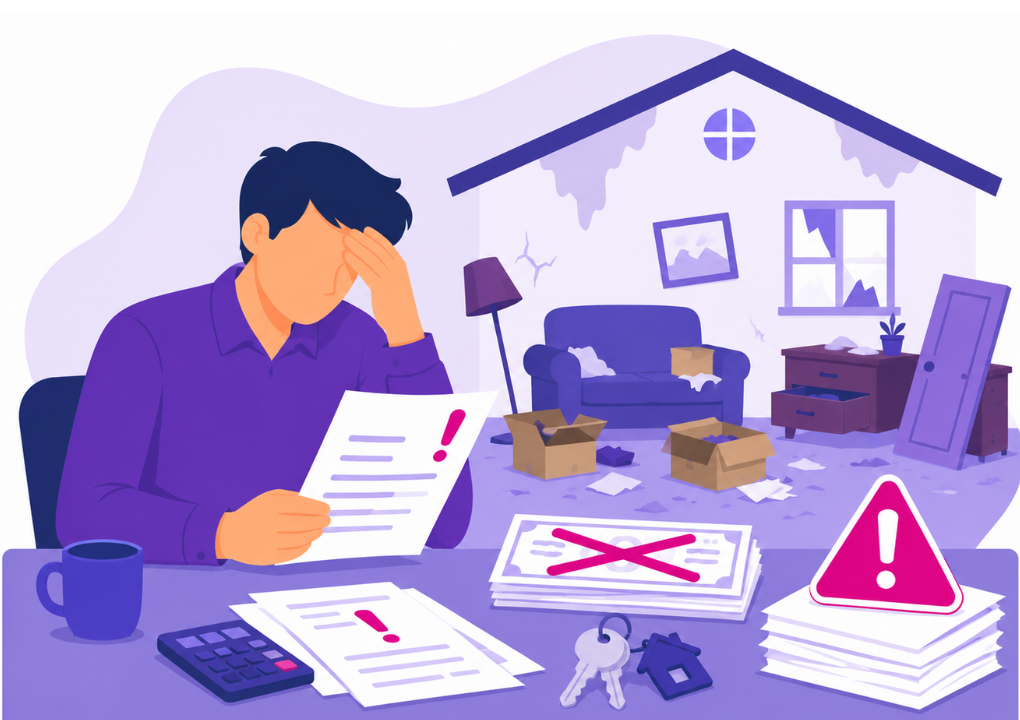
The house was completely trashed.
The tenants had left behind belongings, and the property required extensive work before it could be rented again.
By the time Spencer calculated the lost rent, eviction costs, repairs, and everything else involved, the experience had cost him somewhere in the neighborhood of $15,000–$20,000.
The Real Problem Wasn’t Just the Tenant
It’s tempting to look at Spencer’s story and conclude that the lesson is simply: screen your tenants carefully.
That’s certainly part of it.
But Spencer’s story reveals something more interesting.
He didn’t abandon his screening process because he was careless or because he didn’t know that screening mattered.
He abandoned it because the circumstances made the shortcut feel reasonable.
He was tired of driving back and forth to show the property. He was frustrated that nobody had been approved. Then someone appeared with several months of rent in cash.
The upfront payment created a sense of security—and that sense of security made Spencer relax the very safeguards he had put in place to protect himself.
As he later put it, the money was only part of the temptation. The frustration and inconvenience had already started wearing him down.
Together, they created the perfect storm.
The Hidden Cost of “Brain Damage”
Spencer has a great term for one of the costs that people often ignore when making business decisions: brain damage.
Not everything has a price tag.
Sometimes the cost of a decision is the hours spent worrying about it, chasing people down, driving across town, having difficult conversations, dealing with lawyers, or simply thinking about a problem that shouldn’t have existed in the first place.
Morgan Friedman connected this to the economic concept of transaction costs.
The true cost of an investment isn’t always just the money involved. It’s also the time, frustration, effort, and mental energy required to make the investment work.
For a landlord, showing a property dozens of times might eventually become so frustrating that they’re tempted to take the first apparently acceptable tenant.
But that’s precisely when the discipline matters most.
The inconvenience of following the process can be far cheaper than the consequences of abandoning it.
Don’t Let Expertise Make You Careless
There’s another lesson hidden in Spencer’s story that extends far beyond real estate.
The more experienced we become, the easier it can be to stop following our own advice.
Spencer had already been around real estate. He understood that tenants needed to be screened. He knew the process.
But knowing the rules isn’t the same as following them when you’re tired, frustrated, excited, or convinced you’ve found an unusually good opportunity.
It’s the same phenomenon that shows up in countless professions: the expert who doesn’t update their own website, the marketer who rushes through their own campaign, or the professional who cuts corners on their own project because they know what they’re doing.
Sometimes, being the expert makes you more likely to become careless.
The Tuition You Pay for Experience
Looking back years later, Spencer doesn’t describe the experience as simply a disaster.
It was painful. It was expensive. But it taught him lessons he carried into the rest of his career.
He became more knowledgeable about property management, tenant screening, and the realities of owning rental properties.
Most importantly, he learned that mistakes only become truly valuable when you reflect on them.
The $15,000–$20,000 he lost was, in Spencer’s words, tuition.
And while nobody wants to pay that much for an education, the lessons stayed with him.
The Deal of the Century Might Not Be
Perhaps the biggest lesson from Spencer’s story is also the simplest:
When something seems too good to be true, slow down.
A tenant offering months of rent upfront might be exactly what they appear to be. Or it might be an attempt to get you to skip the process that would have revealed a problem.
The point isn’t to assume everyone is dishonest.
It’s to avoid letting an exciting opportunity convince you that your usual safeguards suddenly aren’t necessary.
Spencer’s first rental property taught him that trusting people isn’t inherently the problem.
Trust without verification is.
And sometimes the most expensive lessons are the ones that teach you why the rules existed in the first place.
